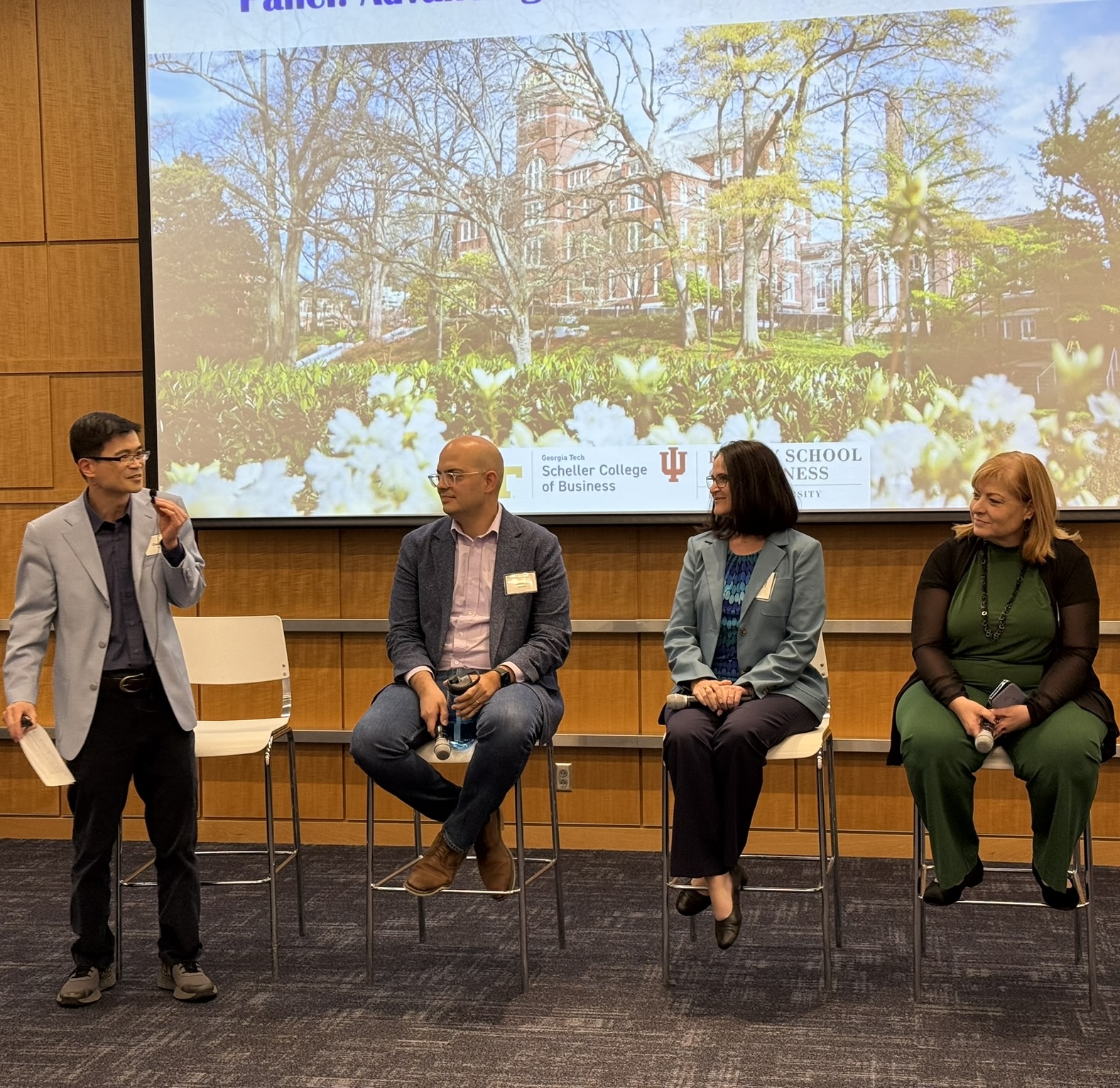
On October 25, 2025, scholars and practitioners gathered at the Georgia State University Knowles Conference Center for the fourth annual Symposium on Environmental and Social Sustainability in Supply Chains. Georgia Tech Scheller College of Business and Indiana University Kelley School of Business co-hosted the event. Owen Wu, associate professor of operations and decision technologies at Kelley, and Suvrat Dhanorkar, associate professor of operations management at Scheller, served as lead organizers. Participants explored how research can inform better business decisions, and how business challenges can inspire more relevant academic inquiry.
Cross-Disciplinary Work: Starting the Conversation
Anuj Mehrotra, dean and Stephen P. Zelnak Jr. Chair at Scheller, opened the symposium by sharing his thoughts on sustainable models of employment and the future of human work in the context of technology-enabled workforces and AI-driven organizations. He also highlighted Georgia Tech initiatives that promote a cross-disciplinary exchange of ideas among stakeholders across technology, innovation, and entrepreneurial interests.
Beril Toktay, Regents’ Professor and executive director of the Georgia Tech Brook Byers Institute for Sustainable Systems, then engaged the audience in a discussion about what fosters the collaborative diffusion of ideas across disciplinary boundaries. In the interactive session, small groups tackled questions such as: How can Ph.D. programs better prepare students for applied sustainability work? What field challenges should shape future research agendas? (Toktay synthesized and presented the insights at the end of the day.)
The interactive session led by Toktay acknowledged a fundamental tension in sustainability work. Academic researchers are rewarded for research publications in top journals. Business practitioners need actionable insights that deliver measurable results. Bridging these worlds requires intentional effort.
The Latest in Sustainability Research
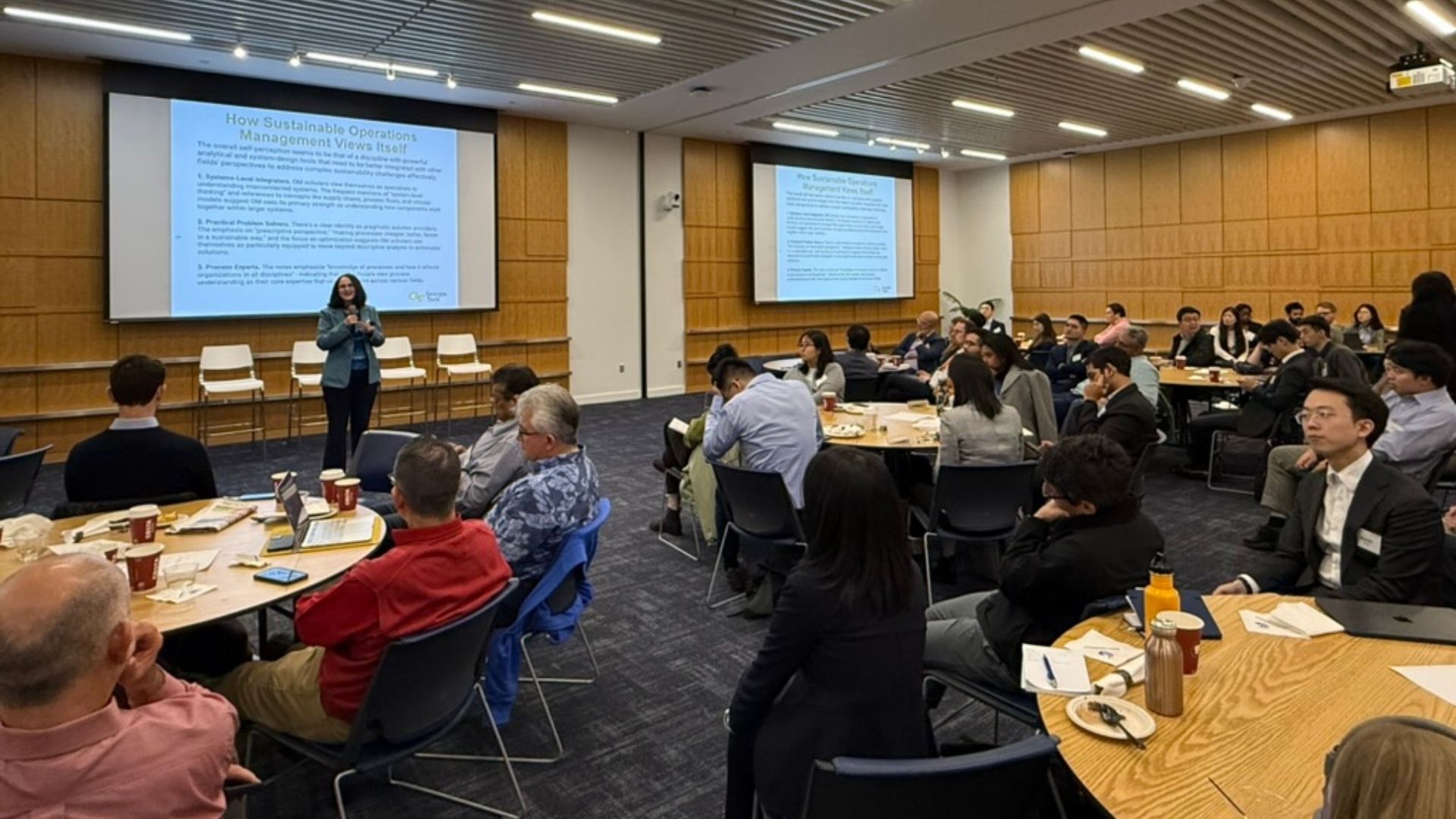
Georgia Perakis, William F. Pounds Professor at MIT Sloan School of Management and editor-in-chief of Manufacturing & Service Operations Management (M&SOM), outlined how the journal is adapting to meet the urgency of sustainability challenges. An environment, health, and society department has been created, and papers are currently being reviewed for a special issue on responsible retail operations.
Perakis showcased recent research published in the journal that demonstrates the breadth of operations management scholarship on sustainability: studies examining regulatory heterogeneity in automobile emissions standards, business models around recycling of ocean-bound plastics, and infrastructure requirements for clean energy transitions, to name just a few. This research provides empirically grounded insights that can inform both policy decisions and corporate strategy.
Symposium attendee Alys Liang, assistant professor of retail and operations management at McGill University, said, "I was very impressed by how the editorial board showcased the integration of practical context with data-driven approaches through concrete paper examples that made expectations clear and tangible."
Navigating Uncertainty in Sustainability Scholarship
Andre Calmon, associate professor of operations management at Scheller, joined Perakis and Toktay on a panel that addressed challenges facing sustainability researchers. Wu, the moderator, led panelists through a variety of topics: How can journals become more receptive to diverse methodological approaches? How should scholars build research agendas when policy landscapes remain uncertain? How can research expand beyond the Global North?
These questions reflect real tensions in academic careers. Junior faculty face pressure to publish in top journals while those journals’ review processes may favor established methodological paradigms. Interdisciplinary sustainability research – which often requires mixing methods, collaborating across fields, and engaging with practitioners – carries additional risks and uncertainties, particularly for scholars seeking tenure. Active audience participation suggested a strong appetite for addressing these challenges.
Practitioner Insights
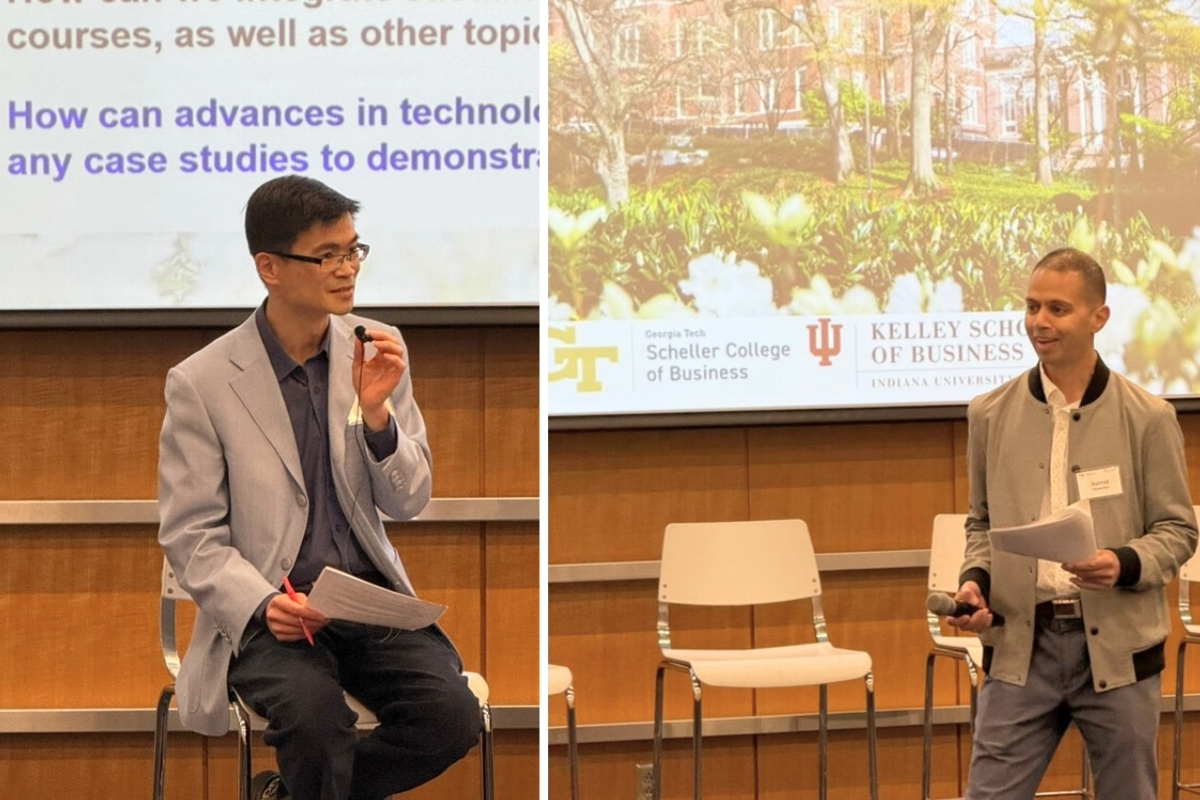
Several presentations and panels highlighted practitioners’ perspectives. Participant Anton Ovchinnikov, associate professor of decision sciences at INSEAD, observed, “The organizers leveraged Georgia Tech’s network and alumni community to bring in industry speakers who offered fresh, grounded perspectives on a wide array of sustainability challenges.”
Ben Jordan (PhD PP ’12), former sustainability director at The Coca-Cola Company, discussed the evolution of corporate sustainability from a compliance-driven afterthought to a central consideration in executive performance evaluations. He said that effective sustainability professionals serve as translators – making the business case for initiatives in language that resonates with teams throughout the company.
Blake Gordon (EMBA ’21), general manager of Georgia-Pacific Recycling, described how his company developed hubbIT, a technology platform that connects waste generators directly with recyclers. Gordon said that waste should not be viewed as a cost center but as a potential profit source. Firms can recover greater value by selling their recyclable materials to end-users such as Georgia-Pacific Recycling. hubbIT helps simplify navigation of the otherwise largely inefficient recycling sector to help them unlock that value.
Calmon moderated a circular economy panel featuring Gordon; Kashi Sehgal, founder and CEO of Retaaza; and Katherine Shayne, founder and CEO of CIRT. Sehgal explained how Retaaza’s local agricultural sourcing reduces waste, increases farmer profitability, and delivers fresher produce to consumers – demonstrating that environmental and economic objectives can align. Shayne shared how CIRT addresses consumer confusion about recycling through simple, accessible guidance.
Drawing Attention to the Real-World Stakes of Environmental Crises
Colinne Bartel, owner of Truffle Time, shifted the conversation from corporate settings to conservation frontlines, examining how climate change and habitat destruction create cascading economic consequences. Her session on wildlife displacement and climate disruption illustrated that environmental challenges cannot be separated from economic realities.
When wildlife populations decline and natural cycles are disrupted, tourism-dependent communities lose income. When agricultural systems face climate volatility, rural livelihoods become precarious. Sustainability is not just about protecting nature for its own sake; it’s about maintaining the ecological foundations that underpin economic activity.
Spotlight on Emerging Scholars
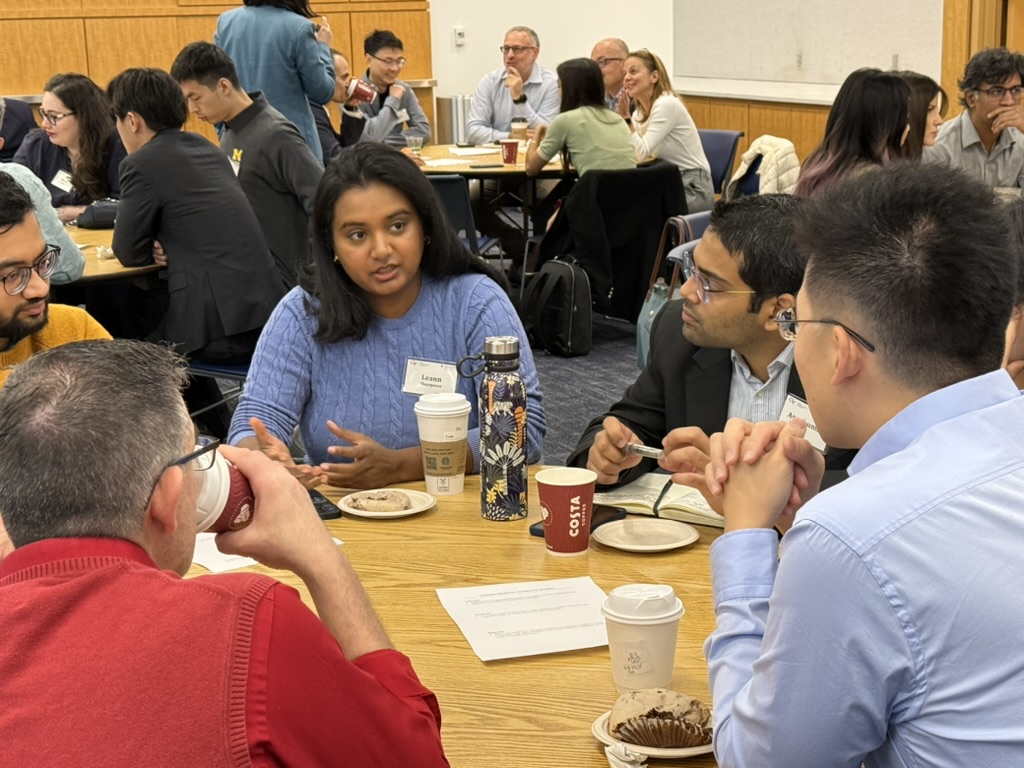
Eight Ph.D. and postdoctoral candidates presented flash talks on their dissertation research, offering a window into emerging scholarship. Their work spanned diverse topics, such as: how ESG initiatives affect operational performance beyond investor signaling, the relationship between menu design and food waste in restaurants, how climate disasters influence green patent filings, and optimizing food bank donations of perishable goods.
These presentations highlighted a notable trend: Many emerging scholars are focusing on actionable questions that have clear implications for business practice – exactly the kind of work that can bridge the scholar-practitioner divide.
Reflections from Participants
The symposium concluded with a reminder that scholarship advances most effectively when curiosity is shared across boundaries – between disciplines, between theory and practice, and between established scholars and emerging researchers.
Ovchinnikov reflected, “This is my third time participating in this workshop, and I remain consistently impressed by both the quality of the content and the excellence of the logistics. The latter is rarely highlighted, but it deserves recognition: co-locating the symposium with the INFORMS Annual Meeting eliminates the need for additional travel for most attendees. In my view, this is a clear example of ‘walking the talk’ on sustainability.”
Hansheng Jiang, assistant professor of operations management and statistics at the University of Toronto - Rotman School of Management, said, “The symposium broadened my perspective on how operations management can advance sustainability. I greatly valued learning from industry practitioners and hearing insights from leading academics.” Jiang also expressed that the symposium was personally meaningful as it helped her connect with research collaborators and find a sense of community.
Liang also praised the event, describing it as “a vibrant, inclusive environment for scholars at all stages to share their insights and perspectives.” She reflected, “The event truly demonstrated how sustainability can be meaningfully embedded into both research and practice through interdisciplinary collaboration.”
For a full report on symposium proceedings, read “Bridging Scholarship and Practice: The 2025 Supply Chain Sustainability Symposium in Atlanta,” a Kelley School of Business blog entry posted by Owen Wu on November 24, 2025.
The symposium was co-organized by the Ray C. Anderson Center for Sustainable Business, with support from Center staff members including Michael Oxman, Allison Bridges and Triniece Smith.
Article written by Angshuman Pal (PhD candidate, Kelley School of Business) with Jennifer Holley Lux (writer/editor, Ray C. Anderson Center for Sustainable Business)
Photography by Jennifer Holley Lux