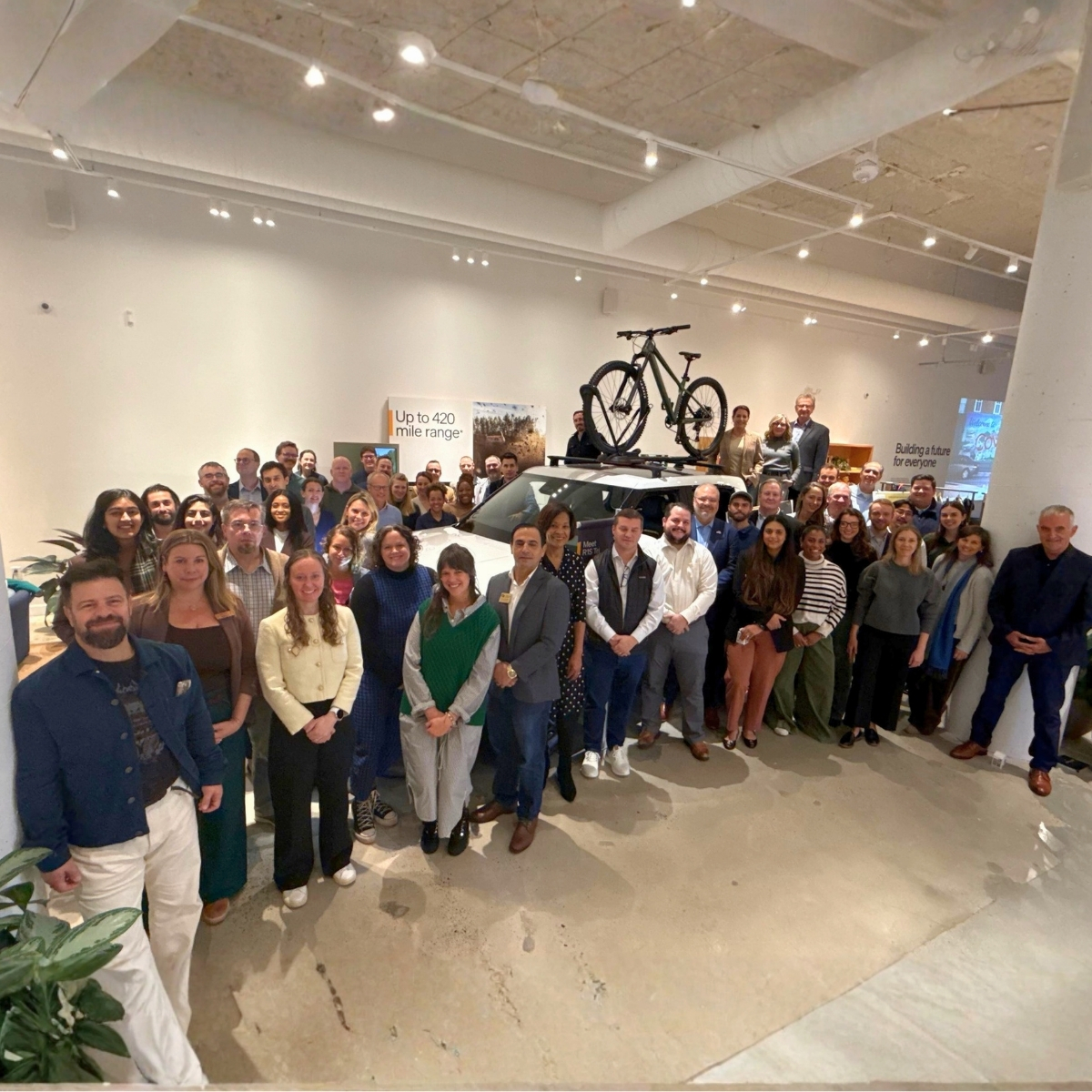
Activating climate solutions at scale in the business community – this is the goal of the Drawdown Georgia Business Compact (Compact). Just over four years since the launch of the initiative in October 2021, the coalition now includes 80 members. The Compact, an initiative of the Ray C. Anderson Center for Sustainable Business (Center) at the Georgia Tech Scheller College of Business, draws upon the Center’s expertise and network of current and future leaders.
In its first years, the Compact focused on building its team and community, while also researching challenges and opportunities within working groups. Having now identified opportunities with broad appeal to member companies, the Compact is putting the plans into action.
“We have some real opportunity to invest in Georgia in ways that will show that sustainability isn’t an add-on but a core element of business strategy,” said David Eady, director of industry engagement. “We can reduce greenhouse gas emissions while bringing new economic value to industry and the state’s economy. These are critical times – where action is more important than words. When it comes to making a positive impact on climate, the time is now.”
A Shared Mission: Building a Community of Practice
Building opportunities for Compact members to come together and learn from one another has been key to the initiative since day one. “Meeting our ambitious climate goals requires more than individual effort – it demands genuine collaboration, thought leadership, and sustained engagement. Time and again, our Compact members have shown up to learn from one another and accelerate meaningful action together,” explained Extension Professional Titiksha Fernandes.
Biannual all-hands meetings give members the chance to connect, hear updates, and discover ways to accelerate collective action. The Compact hosted meetings in May and October 2025, at Accenture and Rivian, respectively. Webinars also provided opportunities to learn about diverse topics – from Georgia’s electricity landscape to regenerative land care. Upcoming events will address sustainable food systems and scaling regenerative landscaping.
The Compact also fosters engagement with the larger sustainability community – to help practitioners, researchers, and students co-create and apply knowledge that advances climate action. The Compact co-sponsored the Super South Summit for Climate Innovation and Impact in April 2025, and is currently helping to plan for the second gathering this spring. Compact members, including CIRT and Retaaza, shared practitioner insights at October’s Symposium on Environmental and Social Sustainability in Supply Chains in Atlanta, where participants explored how research can inform better business decisions, and how business challenges can inspire more relevant academic inquiry.
Georgia Carbon Exchange: Shared Value for Companies and Landowners
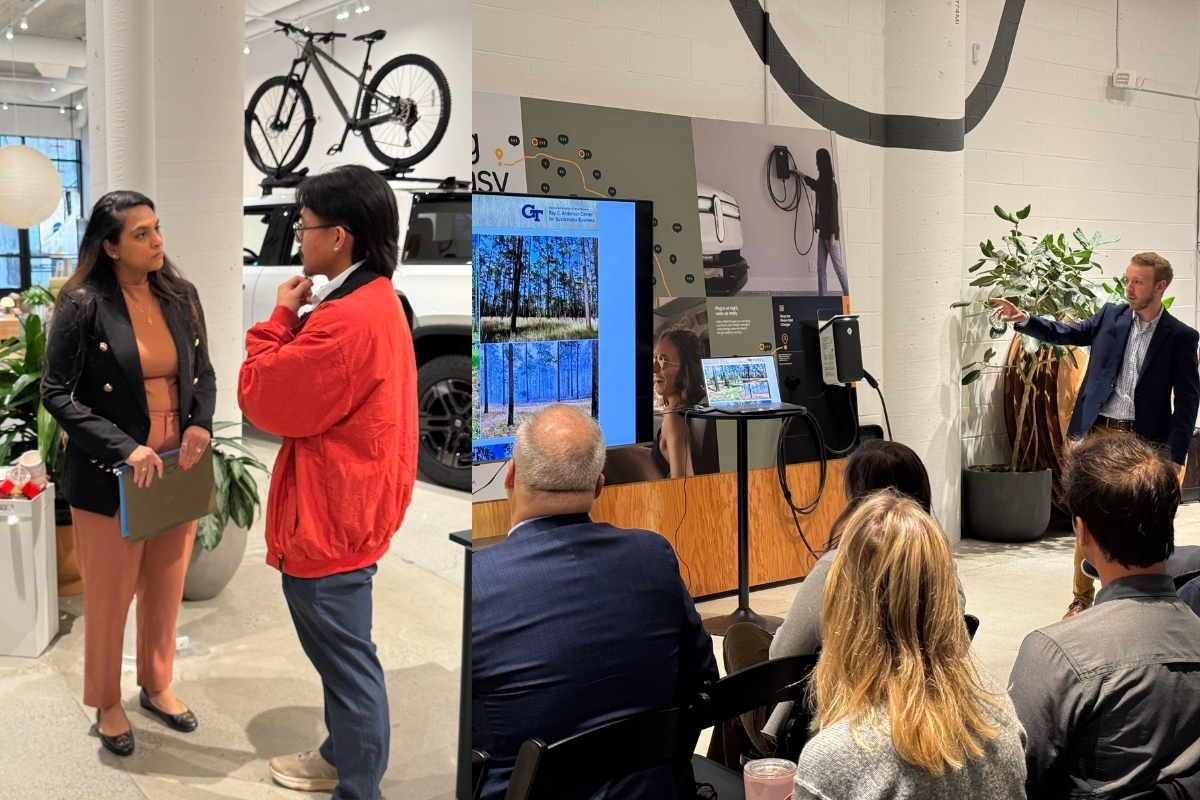
“Georgia forestry is undergoing a period of transformation that presents new opportunities for innovation and resilience,” said Extension Professional Lucas Clay, the Compact’s lead in developing a Georgia Carbon Exchange. “The timber industry has taken a big hit in Georgia due to the closure of several mills. Thousands of acres of forests were decimated in Hurricane Helene. When times become tough for small-acreage landowners, selling land to developers can look pretty attractive.”
Losing forests is bad – for habitats, water quality, and public health. What can help? A high-integrity carbon exchange. Georgia’s economy will get a boost when landowners have a viable option to get income by managing their forests appropriately. Companies that are attempting to mitigate their climate impact will have the chance to participate in vetted, high-quality carbon offsetting that produces environmental and economic benefits within state borders.
The work is spearheaded by the Center in collaboration with the Georgia Forestry Foundation and the University of Georgia Warnell School of Forestry and Natural Resources. The initiative is supported by a forest landowner support grant from the U.S. Forest Service.
Last fall, the steering committee kicked off its work developing Georgia-specific protocols for a submarket of the voluntary carbon market. This committee includes forest landowners, practitioners, and Georgia-based corporations. In 2026, organizers will start a pilot project to develop a carbon exchange specifically for land impacted by Hurricane Helene. At the end of January, stakeholders will gather for a site visit in Metter, Georgia, where they will tour impacted forests, meet impacted landowners, and discuss opportunities for involvement.
Energy Management and Reporting: Helping SMEs Stay Competitive:
A new energy management and reporting course will fulfill a need articulated by Compact members. Allison Bridges, extension professional, said, “We developed the course because Compact companies were telling us – repeatedly – that they need their suppliers to track and report energy and emissions data. It’s crucial because if large companies are doing business in California, they need to report Scope 3 [value chain] emissions beginning with this year’s data.”
The problem is that many suppliers are small to medium-sized enterprises (SMEs) that lack the resources and expertise to report their energy usage. The Center is collaborating with Scheller College Executive Education and the Georgia Manufacturing Extension Partnership in the Enterprise Innovation Institute at Georgia Tech to launch the course that will bring SMEs up to speed. The Spring 2026 course has reached capacity at 15 people, and there is already a waitlist for the Fall 2026 cohort.
The Georgia Environmental Finance Authority is funding the first three cohorts, covering all tuition and fees. After all, there is an economic impact to the state at stake: If Georgia SME suppliers can’t report their energy usage, they will be dropped by large corporations that are required to report emissions across their value chain. Managing energy wisely also helps SMEs save money and remain competitive.
More Opportunities for Impact
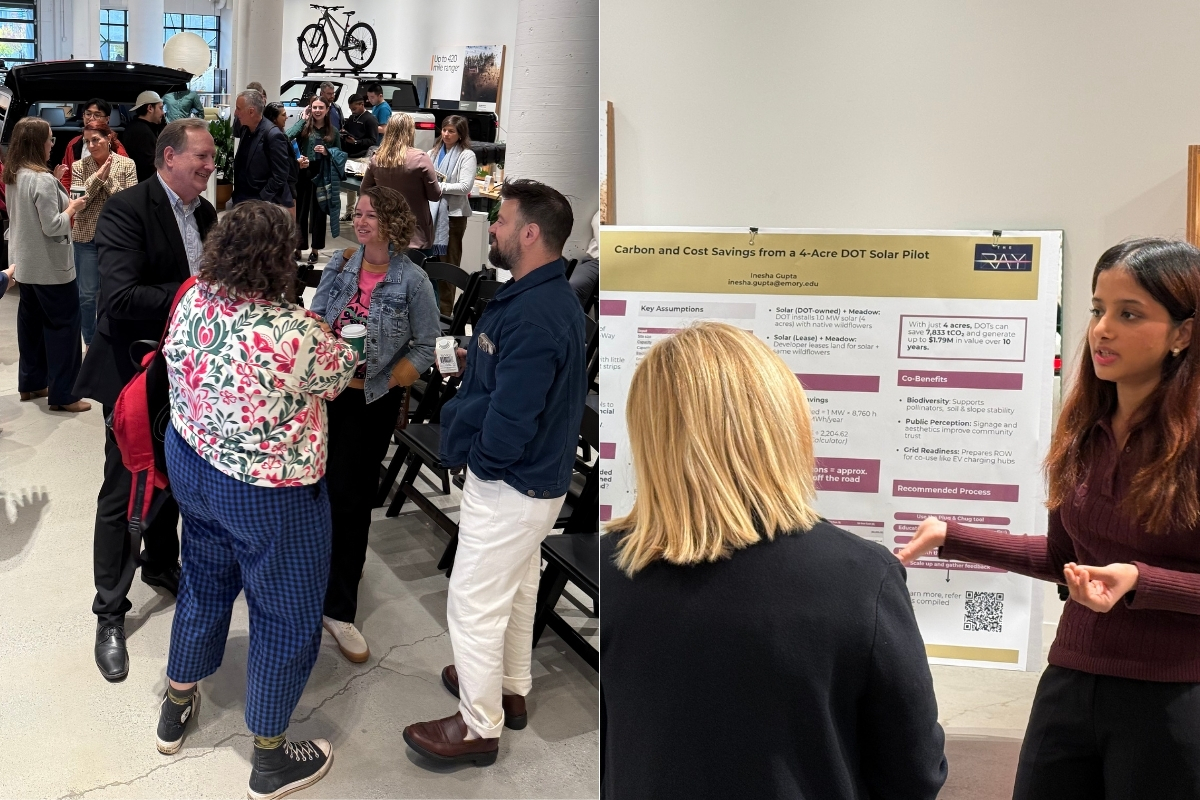
The community of practice, carbon exchange, and energy management and reporting course represent some Compact work that is moving from idea to action. However, by no means are they the only initiatives.
The Compact regularly engages students. For example, member companies sponsoring student projects in the Sustainable Business Consulting Practicum. Also, last year, it facilitated connections with Climate Week NYC and member company Rivian to host a spotlight on student-founded social startups. These founders, participants in the Center’s SUSTAIN-X Scale Lab program, connected with investors and potential customers on a national stage.
Pursuing opportunities for sustainable aviation fuel (SAF) is also a top priority. The Compact and the Center are leading research on Sustainable Aviation Fuel Pathways for Georgia and supported the launch of the Georgia SAF Coalition with key stakeholders.
An essential theme for the Compact is the power of aggregation and how it can be used to send clear demand signals to the market and drive investment in climate solutions. Most Compact member companies are looking to reduce GHG emissions associated with the electricity they use, so this presents an opportunity to aggregate that demand for clean energy through collective procurement. The Compact will be reigniting its engagement with Georgia Power to bring carbon-free power generation to the grid.
Last but not least, the Compact is showing off its sporty side. It recently partnered with the Georgia Tech Student Competition Center and ABB to bring the ABB NASCAR EV Prototype to campus for an event that also featured student-made vehicles. The event signaled the beginning of what is hoped to be an enduring partnership between Georgia Tech, ABB, and NASCAR to pursue electrification in motorsports. Also, the Compact is working to make a positive sustainability impact when all eyes are on Atlanta this summer. The team is working with BoldImpact ATL, a newly formed nonprofit that is taking the lead on SustainTheGame ATL, a sustainability initiative related to the 2026 FIFA World Cup in Atlanta.
If you are interested in learning how to achieve net-zero carbon emissions in the state by leveraging the collective impact of the Georgia business community, email David Eady, director of industry engagement for the Ray C. Anderson Center for Sustainable Business. Are you a business leader in the state committed to sustainable solutions? Join other leading companies by becoming a member of the Drawdown Georgia Business Compact.
Written by Jennifer Holley Lux
Photographs by Ben McDonald and Jennifer Holley Lux