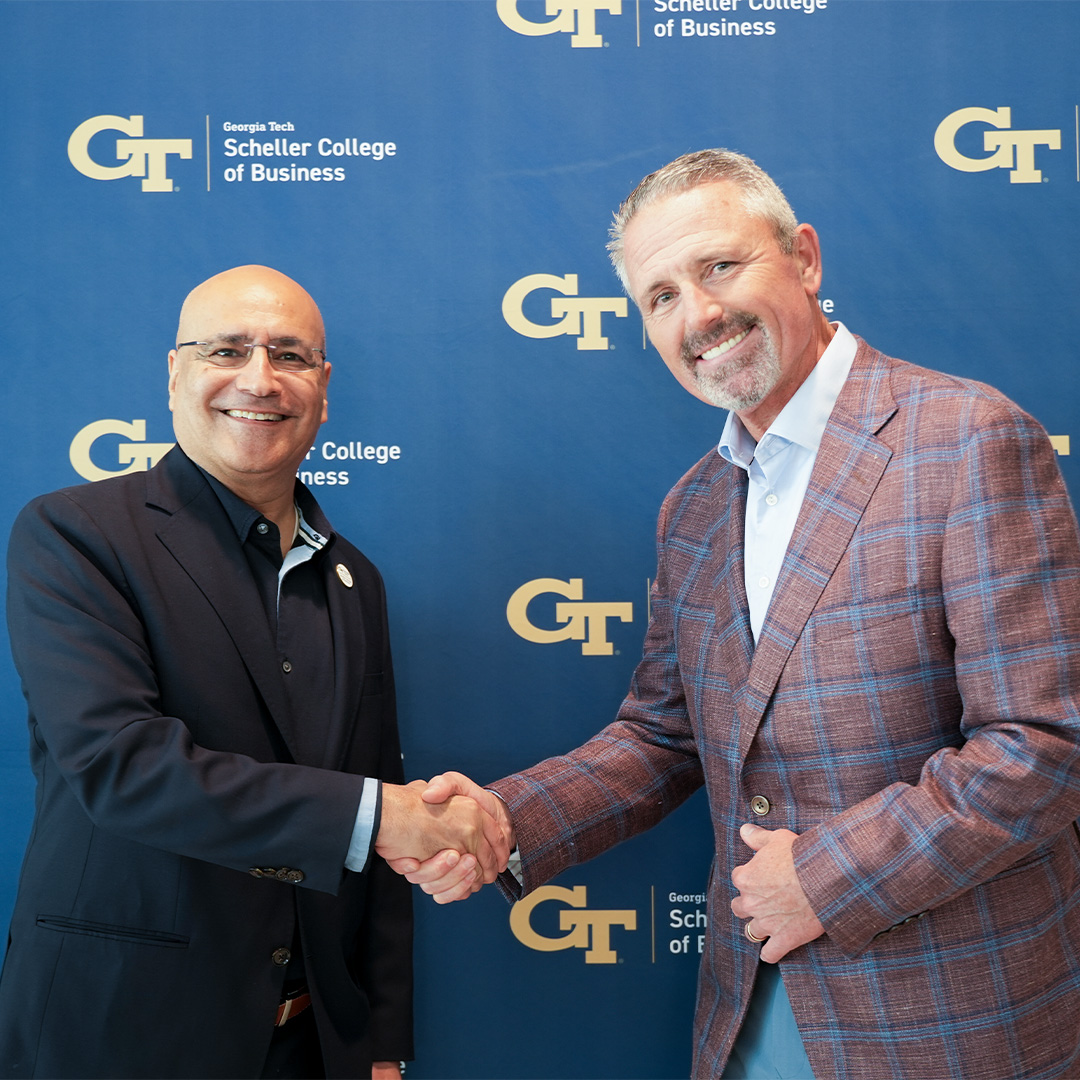

What does it take to lead one of the world's largest privately held companies while empowering an entrepreneurial culture across dozens of businesses?
That question was at the center of a recent Tech Talks Business conversation between Scheller College of Business Dean Anuj Mehrotra and Jim Hannan, president and chief operating officer of Koch. During the discussion, Hannan reflected on his career journey, the principle-based approach to leadership and talent development at Koch, and the opportunities artificial intelligence creates for organizations and employees.
Hannan's own path to senior leadership was anything but conventional. After earning a business degree and beginning his career in public accounting, he moved into the mining industry before joining Koch in 1998. Over nearly three decades, he has held roles in business development, finance, operations, and executive leadership, including serving as president and CEO of Georgia-Pacific, a Koch company, before assuming his current role.
Shared Culture in Action
Hannan described Koch, a privately held company with approximately 150,000 employees in 60 countries, as a collection of diverse businesses united by Principle-Based Management, a philosophy centered on shared principles, empowered employees, and continuous learning.
"We think about ourselves as capability-bound, not industry-bound," Hannan said, explaining how Koch evaluates potential acquisitions and business opportunities. Rather than focusing on specific industries, the company looks for areas where it can apply its capabilities, create mutual benefit, and strengthen its competitive advantages.
Hannan emphasized that organizations perform best when employees at every level are encouraged to contribute ideas, solve problems, and take ownership of outcomes.
"We need 150,000 people showing up to work every day with their lights on," he said, describing a culture where innovation is driven from the bottom up rather than directed exclusively by senior leadership.
For Hannan, building that kind of culture starts with how people are selected and developed.
"We try to hire people on values first, skills second, and credentials last," he said. "If we get somebody in here that has the right values and a lot of intelligence and skills, we can train them if we need to."
For students considering careers at large organizations, Hannan challenged the notion that entrepreneurship exists only within startups. He described entrepreneurship as creating an environment where people are empowered to identify opportunities and apply their unique strengths to solve problems.
AI as a Member of the Team
The conversation also explored one of today's most pressing topics: artificial intelligence.
Hannan described AI as a teammate capable of processing information, automating repetitive tasks, and accelerating innovation, while emphasizing the continued importance of human judgment.
"I think about AI as another member of the team," Hannan said. "What that means is it takes the people who were doing those things and deploys them to higher-value skills."
He noted that Koch is actively experimenting with AI across its businesses, encouraging teams to identify high-value opportunities and scale successful solutions. The company's approach, he said, focuses on learning quickly while ensuring people remain central to decision-making.
Questions and Answers
During a question-and-answer session, Hannan encouraged students to focus less on impressing employers and more on authenticity, curiosity, and a genuine desire to contribute.
"If you're not being yourself, and you're not authentic, and you're not really talking about what your interests are, what you're excited about, what you want to work on, and where your experience is meaningful, organizations will have a harder time understanding how you can contribute," he said.
Throughout the discussion, Hannan returned to a consistent theme: technology may transform how companies operate, but curious, driven people remain at the center of long-term success.
Discover more about career opportunities at Koch.