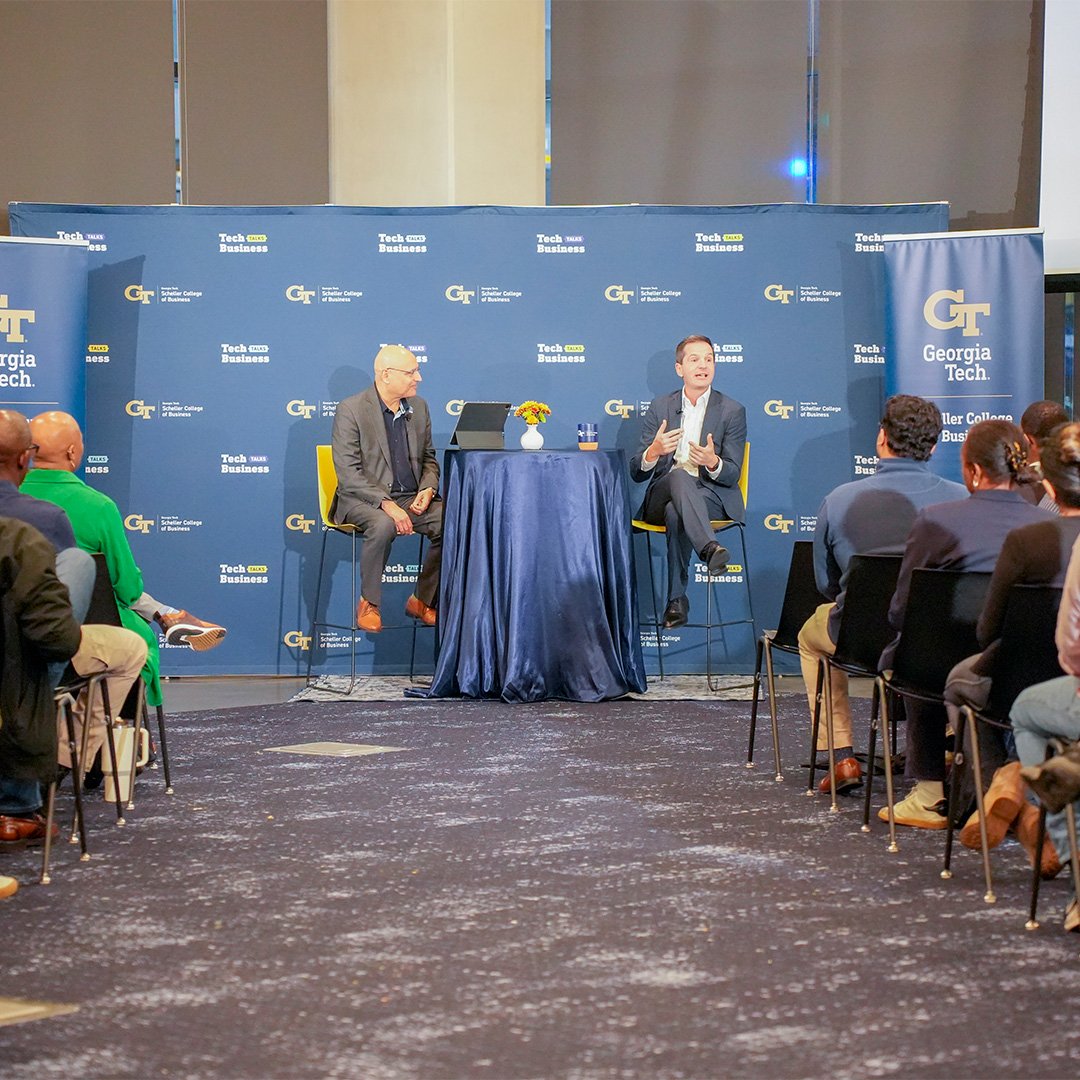
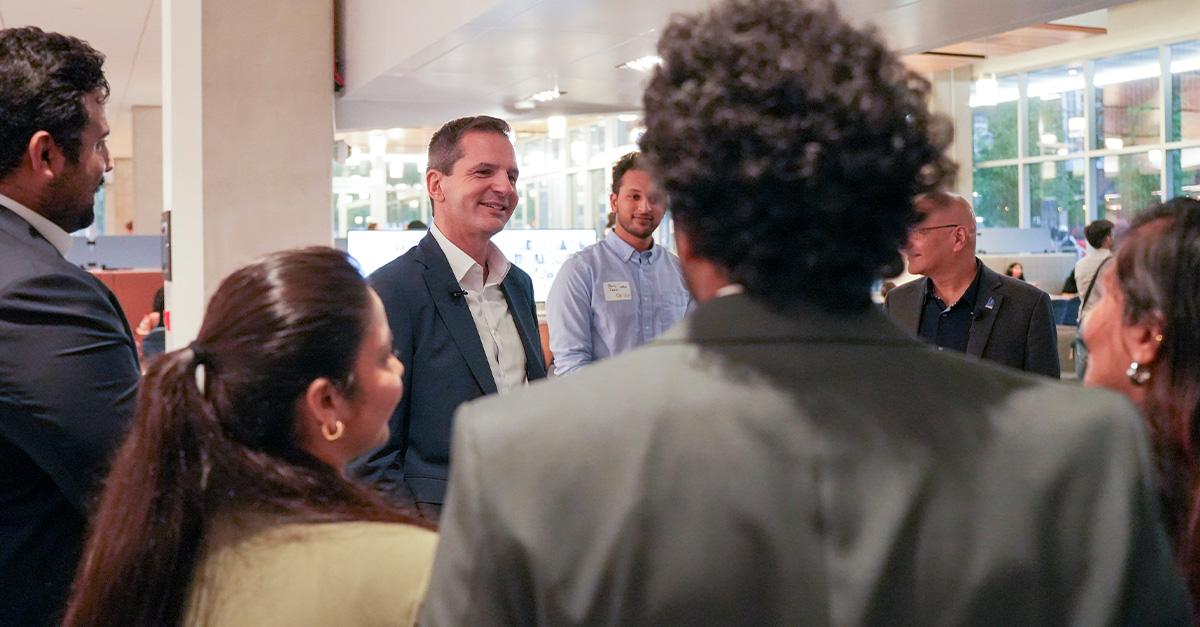
From Formula One racing to artificial intelligence and cyber tires, Claudio Zanardo, president and CEO of Pirelli North America, explored how technology and innovation are shaping the future of mobility during a recent Tech Talks Business conversation at the Georgia Tech Scheller College of Business.
The event, hosted in partnership with the student-led TechForward conference, featured a conversation between Zanardo and Scheller Dean Anuj Mehrotra about Pirelli’s approach to innovation, manufacturing, leadership, and the evolving automotive industry.
With more than 150 years of history, Pirelli has learned that longevity requires continually looking ahead.
“We like to consider ourselves a startup with 150 years of experience,” Zanardo said. “This is how we need to act. This is how we need to be in the market.”
From Formula One to the Road
Perhaps nowhere is Pirelli’s focus on innovation more visible than in Formula One, where the company’s tires operate under extreme conditions and must keep pace with cars that are continually evolving.
Zanardo explained that for Pirelli, motorsport serves as more than a marketing platform. It acts as a testing ground for new materials, virtual development tools, logistics systems, and sustainability initiatives that can ultimately influence consumer products.
“Formula One is the peak of the peak,” Zanardo said. “The technology you apply there is unique. It gives us a unique point of view and the possibility of developing new things that you would otherwise never start doing.”
Because Pirelli must begin developing tires before the next generation of Formula One cars physically exists, the company relies extensively on virtual development and simulation, an approach that helps accelerate innovation across the broader business.
Building a Smarter Tire
One of Pirelli’s most significant innovations moves technology directly into the tire itself.
The company is developing sensor-equipped, or “cyber,” tires that collect information including temperature, pressure, tire wear, and road conditions. That information can be communicated to the vehicle, allowing its systems to react more quickly to changing conditions.
“The only thing that is touching the ground is the tire,” Zanardo said. “The tire can give us a lot of information, a lot of data.”
That data could eventually help vehicles shorten braking distances, detect hazardous road conditions, alert other vehicles to dangers ahead, and support autonomous driving. Pirelli is also exploring how tire-generated data could identify deteriorating roads and help communities determine where repairs are needed.
“The next frontier is that the vehicle recognizes this, reacts, and then tells the vehicle following it, ‘Be careful, because there is a hazard,’” Zanardo said. “When these things work together, the entire system will be much safer.”
AI, Manufacturing, and the Future
Artificial intelligence is already helping Pirelli make decisions beyond the vehicle.
Zanardo said the company uses AI for predictive maintenance in its factories, quality inspections, research and development, materials innovation, and forecasting future demand.
That long-term view is important in Georgia, where Pirelli plans a $1.2 billion investment in its Rome manufacturing operation. The goal is to reach an annual production capacity of 6 million tires by 2033.
Yet even as AI assumes a larger role, Zanardo emphasized that technology cannot replace the adaptability and creativity Pirelli looks for in its people.
“We need to be the most innovative company, even if we are the smallest one,” he said. “We use the AI tools but keep the humanity; that is the game changer.”
Questions and Answers
During the Q&A, Zanardo offered students advice for navigating a world where AI can increasingly provide instant answers.
The value of an education, he said, lies not only in reaching the correct answer but in developing the knowledge, judgment, and critical-thinking skills acquired along the way.
“AI tools are extremely important, but they are fast. They give you the answer immediately,” Zanardo said. “Students should keep in mind that we are not always just looking for the answer. We are experiencing the journey to arrive there. The journey is fundamental.”
For universities and businesses alike, he said, preserving that process will become increasingly important as technology advances.