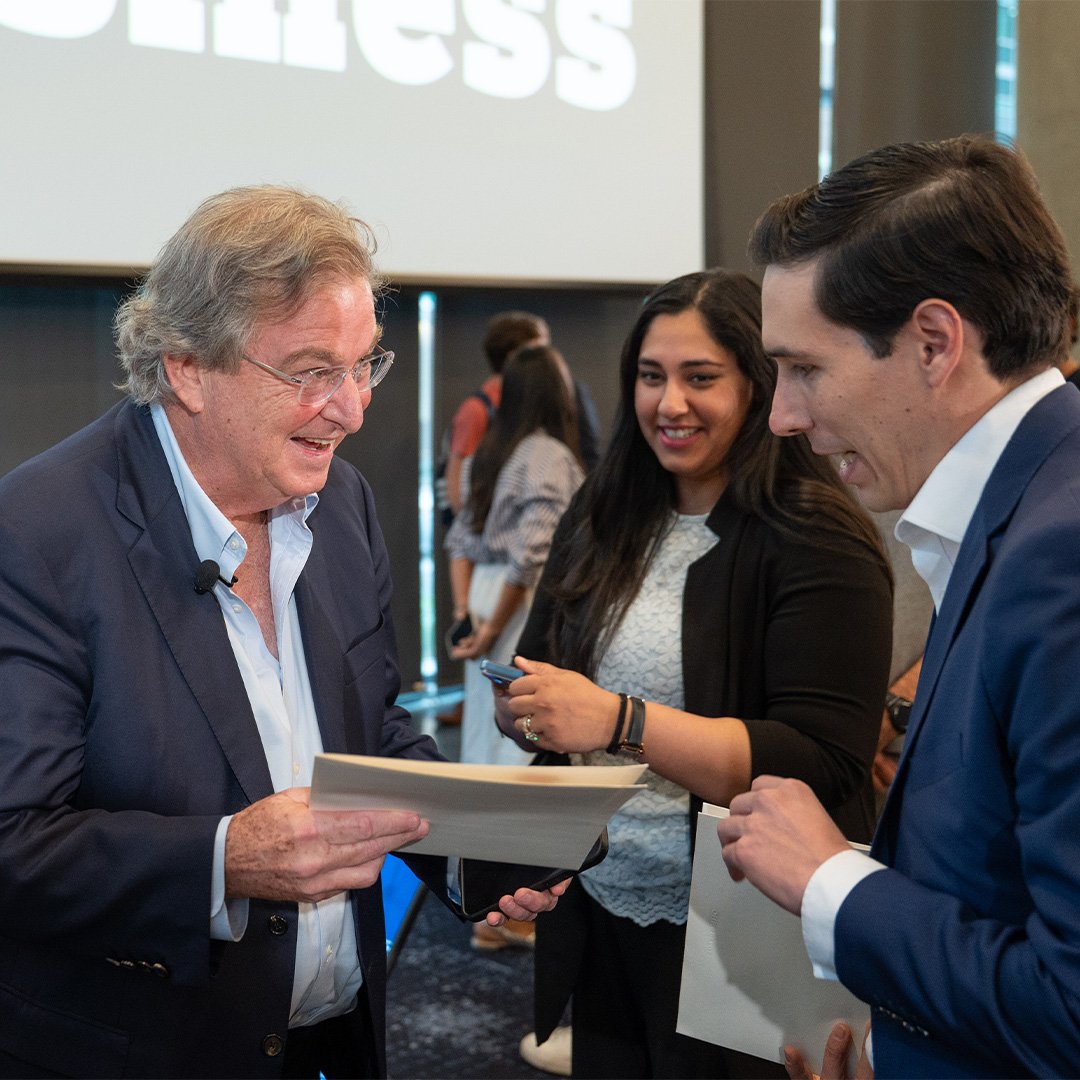
When Jaime Gilinski arrived at Georgia Tech in 1974, he was a 16-year-old student from Colombia with "a suitcase and a dream."
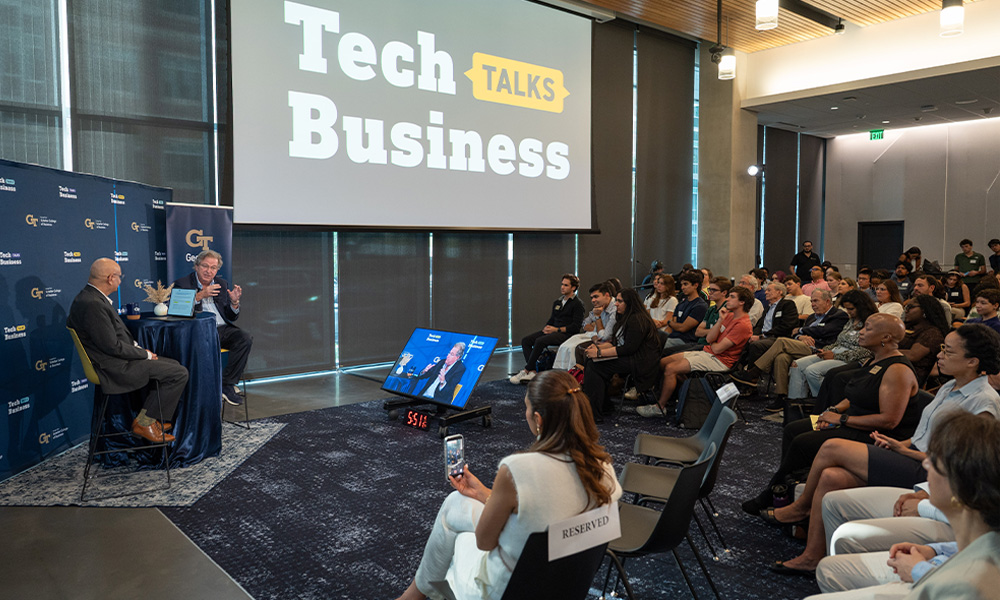
More than five decades later, Gilinski returned to campus to join Dean Anuj Mehrotra as a featured guest in the first Tech Talks Business session of the Fall 2026 season.
Now CEO of Grupo Nutresa and one of Latin America's most influential business leaders, Gilinski sharedlessons on entrepreneurship, transformation, resilience, philanthropy, and purpose-driven leadership.
Starting Small, Thinking Big
Speaking with Mehrotra before a packed audience of students, alumni, faculty, and industry leaders, the Georgia Tech industrial engineering alumnus (IE ‘78) reflected on how his time on campus shaped the foundation of his career.
"I came to Georgia Tech in September of 1974,” Gilinski said. “I was 16 years old. My dream was to workreally hard and hopefully go back to Colombia one day and do good things."
The experience, he said, equipped him with skills that would guide him throughout decades of business leadership.
"I think that the school taught me how to think, how to have perseverance, and how to fight, which is what I have done during my whole life."
After graduating from Georgia Tech, earning an MBA from Harvard, and working for a year at Morgan Stanley, Gilinski returned to Colombia determined to build businesses and create opportunities.
One of his earliest successes came from convincing Procter & Gamble to partner with him on an acquisition. It wasn’t easy. He started writing letters to the chairman of Procter & Gamble in Cincinnati; each letter went unanswered.
Rather than giving up, Gilinski traveled to Cincinnati uninvited and left a note at company headquarters. Itcaught the attention of a senior executive, who eventually agreed to fly out to Medellin to consider Gilinski’s proposal. Years of persistence followed.
After four years, 42 trips to Medellin, and meeting many members of the P&G family, Gilinski convinced them to acquire the Colombian business together. Today it’s one of the largest consumer product companies in the country. The experience became an early lesson that would shape much of his career.
The Talent Behind Every Transformation
Mehrotra noted that throughout his career, Gilinski has repeatedly stepped into underperforming companies and transformed them into successful enterprises. Rather than emphasizing financial strategy alone, Gilinski pointed to people as the critical factor.
Successful transformation, he argued, comes from empowering employees with responsibility, authority, vision, and incentives.
"If you motivate them, give them vision, and the responsibility and authority to act, and at the same time the incentives to do it, they can do it,” he said.
That philosophy continues to guide his leadership at Grupo Nutresa, where he retained much of the existing leadership team after taking control of the company.
"We have great talent," he said. "What you really have to do is not only work hard but give very clear vision and stick to it."
Why Gilinski Is Bullish on Latin America
When Mehrotra broadened the discussion to the future of Colombia and the wider region, Gilinski expressed strong optimism.
"I am absolutely bullish on Latin America," he said. "In the next 10 years we will have one of the best periods of growth in Latin America."
He cited the region's talent, natural resources, growing economies, and emerging opportunities across industries, pointing specifically to Colombia's hardworking population and long-term economic resilience.
"It's a country that has suffered a lot," he said, "but it's a country that has always performed."
People Still Matter
No discussion about the future of business would be complete without artificial intelligence. While acknowledging that AI is already improving operations across Grupo Nutresa, Gilinski cautioned against overlooking the continued importance of human judgment and relationships.
"We are applying a lot of AI," he said. "I still think we need the judgment of human beings behind every operation."
The company is using AI to improve efficiency in manufacturing operations, and Gilinski said he remainscommitted to a leadership style built on direct human interaction.
"I'm old school in that I like to talk to a person," he said. "I like to discuss with people and take many meetings every day to counsel with my team."
Education, Philanthropy, and Responsibility
Mehrotra also highlighted Gilinski's philanthropy, including his family's support of Georgia Tech and recent disaster response efforts following devastating earthquakes in Colombia.
For Gilinski, philanthropy begins with education.
"I think that the future of a company and the future of a country is to have educated human beings," he said.
He described efforts to support students through scholarship programs, alongside initiatives focused on hospitals, schools, food banks, nutrition programs, and earthquake recovery.
When discussing leadership more broadly, he framed helping others as a responsibility that accompaniessuccess.
"I feel that we as leaders, as business people and human beings, we have to help the ones who don't have a chance,” he said.
A Lesson in Perseverance
During the audience Q&A, students asked questions that centered on perseverance.
When one student entrepreneur asked for advice on connecting with another entrepreneur, Gilinski drew onlessons from his own experience pursuing Procter & Gamble decades earlier.
"Send that letter," he said. "If the answer is no, keep sending more letters."
Later, when asked whether there were times perseverance wasn't enough, Gilinski offered a candid answer.
"There have been times in which I have had investments or businesses that no matter how much I work, you cannot succeed," he said.
His advice to leaders in those moments was to recognize reality, adjust course, and continue moving forward.
"You have to accept that you didn't do it and turn your attention to other things,” he said.
The Challenge That Matters Most
Near the end of the evening, an audience member asked what challenge remains unresolved despite Gilinski's business success.
His answer had nothing to do with acquisitions, growth strategies, or global markets.
"I want to spend more time with my children and my grandchildren," he said.
Business leaders, he noted, often dedicate enormous energy to their organizations but struggle to maintainbalance, something he is looking for at this later stage of his career.
For the students in attendance, the evening offered insights into entrepreneurship, leadership, and transformation. But Gilinski's most enduring message may have been the same lesson that carried him from Georgia Tech to a global business career — a determination to work hard, stay resilient, and keep moving forward.
As he told the audience, "You have to keep on fighting."