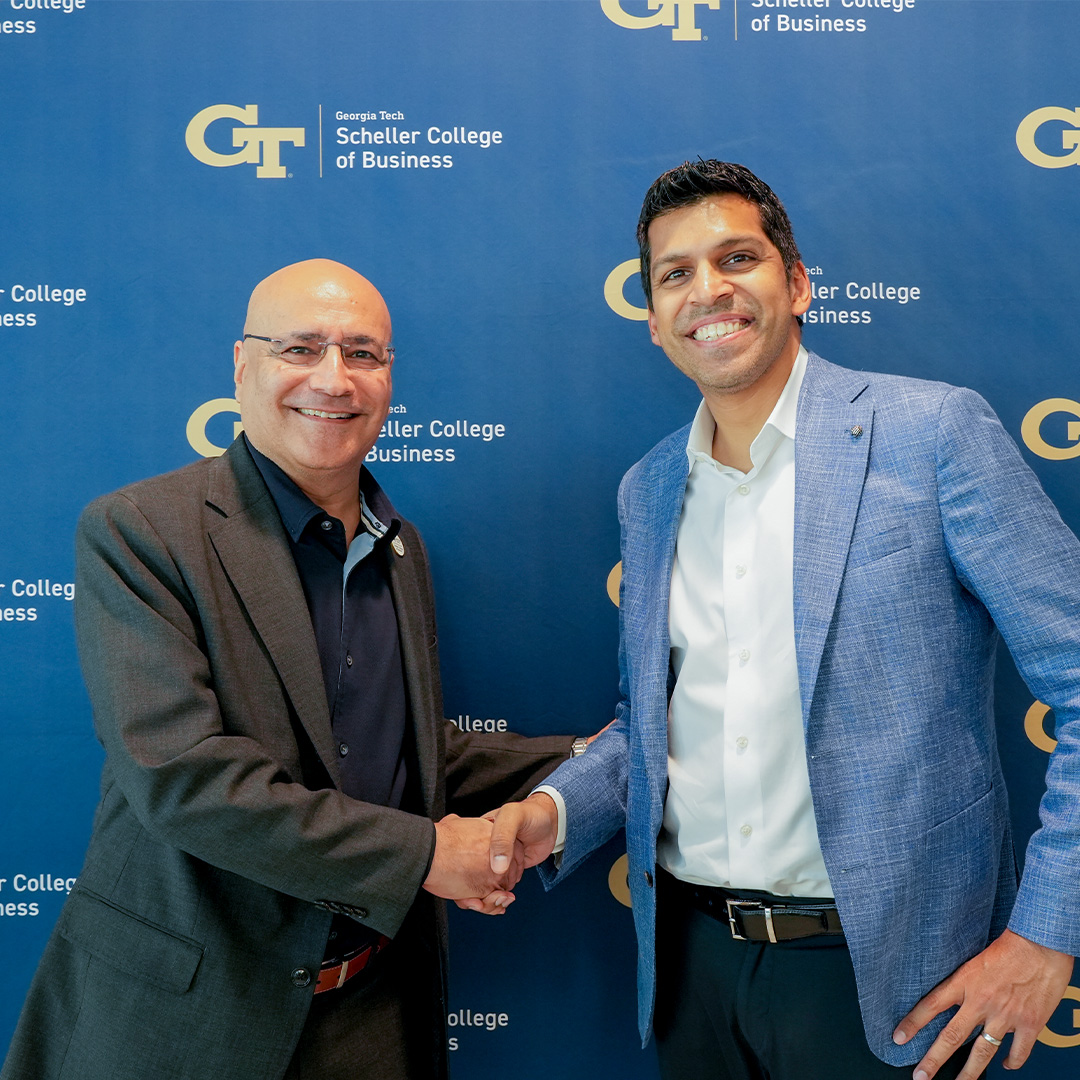
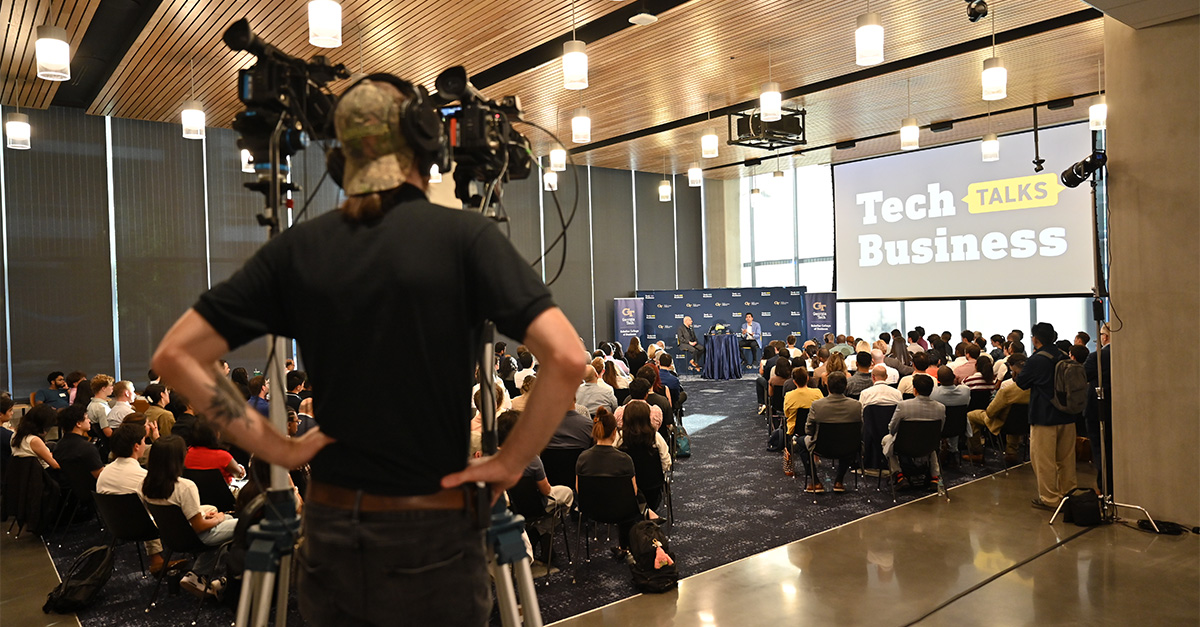
Avant South partnered with the Scheller College of Business' signature Tech Talks Business series for a closing fireside featuring Aaron “Ronnie” Chatterji, chief economist at OpenAI and the Mark Burgess and Lisa Benson-Burgess Distinguished Professor of Business and Public Policy at Duke University.
Artificial intelligence may be advancing rapidly, but Chatterji said its ultimate impact will depend not only on technological advances, but also on the leaders, workers, and organizations that put those tools to use.
A professor by training, Chatterji has worked at the intersection of academia, government, and business. Before joining OpenAI, he advised the Obama and Biden administrations on economic policy and served as chief economist at the U.S. Department of Commerce.
“I never really expected to be working full time for a business,” he said of joining OpenAI. “But going to OpenAI, I sometimes feel like I’m in much more of a research organization than a traditional company, and that’s been something that’s been really easy to adjust to as an academic who’s now in the private sector.”
From Answers to Action
Chatterji described AI’s recent development as a progression from answering questions to reasoning and, increasingly, acting on a user’s behalf. That shift toward “agentic AI” allows people to delegate tasks and create repeatable workflows rather than use AI only as a chatbot.
“For most people using AI, and for most people thinking about AI, a lot of the economic models are thinking about AI as a chatbot, an ask-and-answer machine,” he said. “When you think about AI that way, it does limit the imagination in terms of thinking about the economic impact.”
While AI’s capabilities have grown faster than he anticipated, Chatterji said its effects on the labor market have unfolded more slowly. Organizations require time to adopt new technologies, redesign processes, address governance questions, and determine how AI fits into existing jobs.
“It was always more likely to me that AI would be a complement, not a substitute, initially to people at work,” he said. “It hasn’t surprised me that AI has become a tool at work, but it hasn’t taken over entire jobs.”
Rather than relying on sweeping predictions, his team examines labor-market data as it becomes available. Although he is closely watching early-career hiring, he cautioned that it can be difficult to separate AI’s influence from interest rates, economic cycles, and other factors affecting employment.
“You are seeing work change, and that can be a harbinger for things to come,” he said. “But what we need to do is look at the data as it comes in.”
Leadership Is Essential to AI Adoption
For companies, successful AI implementation requires more than access to sophisticated tools. Chatterji said senior leaders must rethink how work gets done, champion adoption, and manage organizational change.
“You still need human leadership and change management to implement AI,” he said. “Organizations need to rethink how work gets done and, in some cases, create entirely new workflows designed around AI.”
Without leaders empowered to address legal, data, and operational barriers, companies risk developing pilots that never scale, he said.
Chatterji also warned organizations against responding to AI by eliminating entry-level hiring. Companies still need employees who understand how AI-generated work is produced, can evaluate its outputs, and are accountable for decisions.
“If we’re not hiring humans to understand what the inputs and outputs of AI are and be accountable for it, we’re not going to run an effective organization,” he said.
Questions and Answers
During a Q&A session, students asked how they could prepare for an AI-enabled workplace. Chatterji emphasized the importance of being able to demonstrate how they have used AI to create something valuable. Technical proficiency alone, he added, is insufficient if a candidate cannot explain the work or connect it to a business decision.
“You have to show evidence that you’ve used AI to build something valuable to the employer,” he said. “Being able to show that you can explain what you produce is incredibly important.”
He expressed particular concern about preserving critical thinking in education. AI can complement a person’s expertise, he said, but students who use it as an “easy button” risk missing the foundational knowledge necessary to critically evaluate AI-generated answers.
“I see AI kind of like the calculator,” he said. “You’ve got to learn the basics before you introduce it into education.”
Chatterji closed by affirming the value of a college experience that brings students together across disciplines, connects them with research, and builds relationships that technology cannot replace.
“As machine intelligence is ascendant,” he said, “what makes us human is maybe more valuable.”