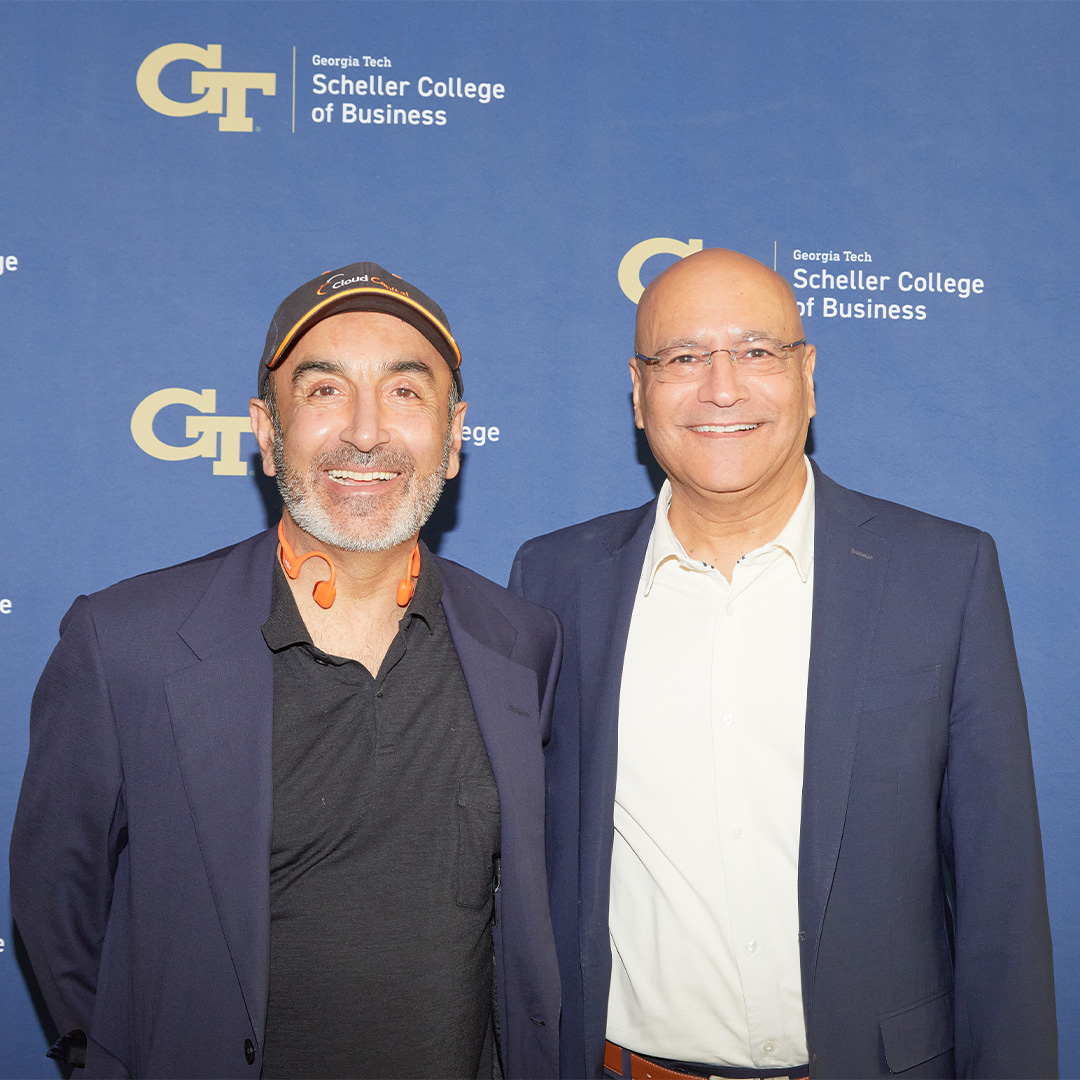
Hossein Fateh, founder and CEO of CloudHQ, LLC, built his career by spotting opportunity where others saw uncertainty. During a Tech Talks Business conversation with Dean Anuj Mehrotra at Georgia Tech’s Scheller College of Business, Fateh walked the audience through the unlikely beginnings of his career, explaining how those early decisions helped shape today’s global digital infrastructure.
“I’m a real estate guy by background,” Fateh said, describing the moment that launched his entry into data centers during the dot-com bust of the early 2000s. At the time, Fateh owned a large, unfinished building leased by Exodus Communications, a data center company that collapsed when many of its dot-com clients went bankrupt.
“In the bankruptcy court, I negotiated to keep $55 million of their infrastructure,” Fateh said. “I got in at the time when everybody else wanted out. I saw an opportunity come by, and I grabbed it.”
That decision laid the foundation for Fateh’s career in data center development. Instead of treating data centers as short-term rentals, he reimagined them as long-term real estate assets, an approach that allowed him to finance growth and scale the business.
“I developed the first triple-net model, turning an operating business into a real estate business,” Fateh explained. “Rather than having month-to-month contracts, I had multiyear contracts that were triple net.”
That model eventually led Fateh to take DuPont Fabros Technology public as a real estate investment trust (REIT) in 2007, with a valuation of $7.8 billion. After running the company for eight years, Fateh stepped away to start CloudHQ, applying lessons learned from earlier chapters of his career.
“I realized the model that I had actually helped start was not the best model anymore for development,” he said. “A REIT is very bad at holding land.”
Building for the Long Term
As Fateh’s career evolved, so did the scale and ambition of what he was building. Today, CloudHQ operates as a global developer of data centers, with projects spanning multiple continents and a workforce that continues to grow at a rapid pace. Fateh described the company’s expansion not as a sudden leap, but as the result of applying lessons learned over decades in real estate, finance, and infrastructure.
“We are in 13 countries and 22 markets worldwide,” he said, noting that CloudHQ and its affiliated investment platform, Cloud Capital, now employ more than 350 people. “We’re hiring about 1.2% per week.”
That growth is fueled by a steady and accelerating demand for data centers, the facilities that quietly power much of modern life. During the conversation, Fateh explained how the digital economy has changed over time, grounding abstract trends in familiar experiences.
“In 2004, it was the search wars with Google, Yahoo, Bing,” he said. “Then it was social media.” A few years later came streaming, as Netflix pivoted from mailing DVDs to delivering movies instantly. Online gaming, ride-sharing apps, and food delivery services followed as internet speeds improved and new geo-positioning possibilities emerged.
“Every time internet speeds increase, we find a new application that is formed,” Fateh said.
Artificial intelligence, he explained, is simply the latest and most power-hungry chapter in that story.
Power as the Limiting Factor
Despite the surging demand for data centers, Fateh was candid about what keeps growth in check. The challenge, he said, is not finding customers or capital; it is securing enough electricity in the right places to keep the digital world running.
“Our limitation is power,” Fateh said plainly. “That’s what’s holding us back.”
As applications become more data-intensive, especially with the rise of artificial intelligence, power needs to increase at a scale few outside the industry fully appreciate. Fateh explained that while training AI systems may happen in centralized locations, using those systems in real time—what the industry calls “inference”—requires enormous amounts of electricity close to where users are located.
“One megawatt of training could be five to 10 megawatts of inference,” he said.
That reality shapes how CloudHQ selects sites and plans future developments. Location matters, but so does infrastructure — land that is already connected to power grids and fiber networks can determine whether a project succeeds.
“About half the money is made on the land,” Fateh explained. “You get the land, you get the power to it, you get the fiber to it, you get the permits. That’s 50 to 60% of our end profit.”
For Fateh, long-term strategy increasingly comes down to a single question: Where can reliable power be accessed today and where will it be available tomorrow?
Environmental Concerns
As data centers grow larger and more visible, they have also drawn scrutiny from surrounding communities, particularly over environmental impact. Fateh acknowledged that those concerns are often fueled by misunderstanding—and that the industry shares responsibility for the confusion.
“I think we have done a terrible job of explaining that to our neighbors and to society,” he said.
Throughout the discussion, Fateh emphasized that data centers are not abstract or distant infrastructure. They exist to serve everyday activities that people depend on without thinking twice.
By consolidating computing power into centralized facilities, data centers can operate more efficiently than many decentralized alternatives. “For every dollar of electricity, I only spend 15 to 25 cents cooling,” he said, noting that modern facilities are designed to maximize efficiency and resilience.
CloudHQ also adapts its designs depending on local conditions. In some regions, the company uses recycled water; in others, it relies on closed-loop systems that require no water at all.
Final Takeaways
For Fateh, the path forward lies in greater transparency, helping communities understand why data centers exist and how deeply they are woven into daily life.
“You’re going to need data centers,” he said. “Whether it’s education, healthcare, or just finding your way in the dark — this is part of life. We are simply the landlords of the data.”
For students and aspiring entrepreneurs in the audience, Fateh’s story offered a clear takeaway: Lasting success comes from recognizing cycles, acting decisively, and building models that can endure change.
“When luck comes by, you have to grab it,” he said.