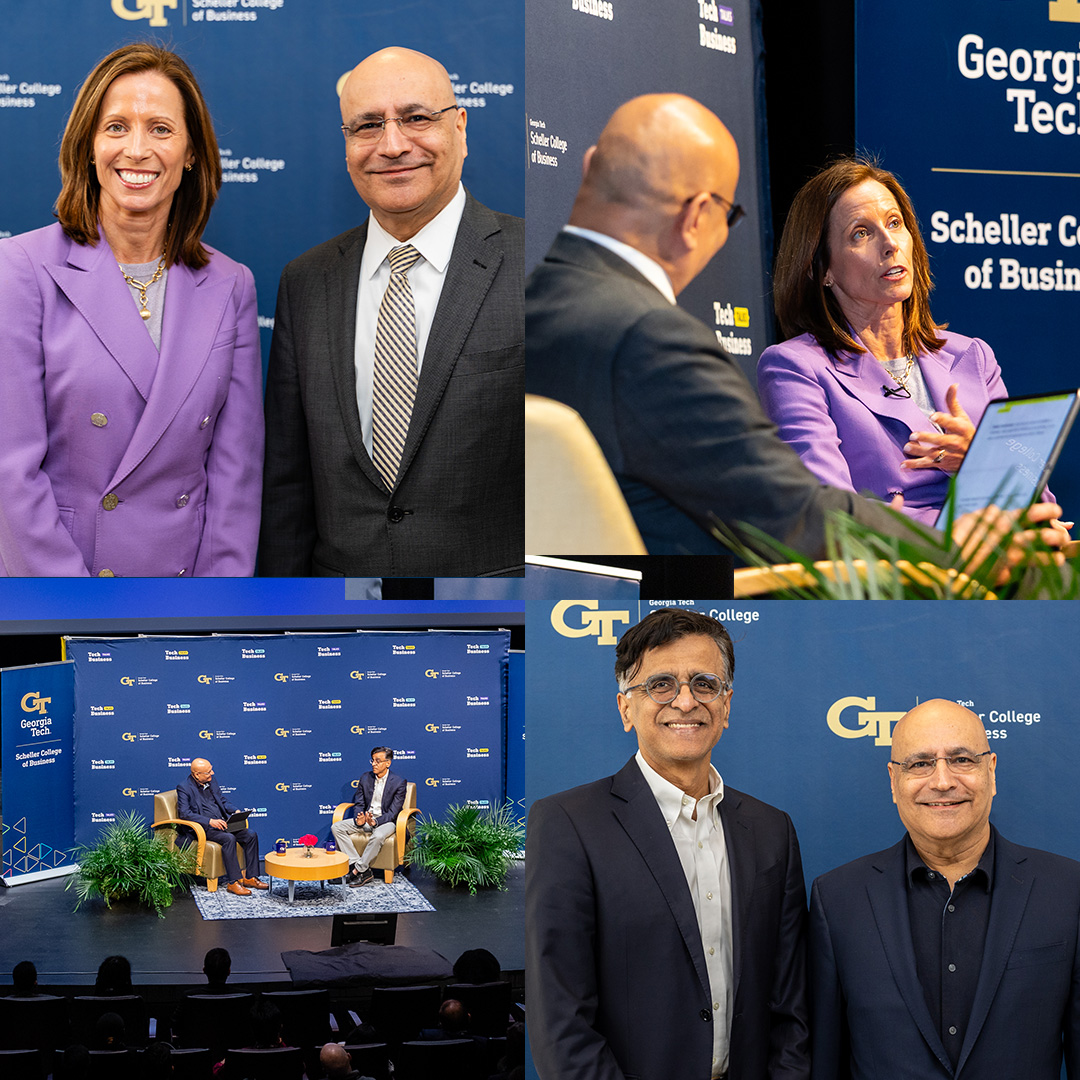
Tech Talks Business Features Adena Friedman, Chair, CEO of Nasdaq; and Sridhar Ramaswamy, CEO of Snowflake

During two Tech Talks Business sessions at the 2026 AI and Future of Finance Conference, Nasdaq Chair and CEO Adena Friedman and Snowflake CEO Sridhar Ramaswamy explored how trust, data and leadership will shape responsible AI innovation across global markets and enterprise platforms.
Four photos of Tech Talks Business sessions featuring Adena Friedman, Chair, CEO of Nasdaq; and Sridhar Ramaswamy, CEO of Snowflake.

Adena Friedman, Chair, CEO of Nasdaq; and Sridhar Ramaswamy, CEO of Snowflake.

The 2026 AI and Future of Finance Conference included two special Tech Talks Business sessions. Industry leaders discussed the future of AI and its impact on financial institutions and cloud-based platforms. Dean Anuj Mehrotra welcomed Adena Friedman, Chair and CEO of Nasdaq, on March 19, and Sridhar Ramaswamy, CEO of Snowflake on March 20. 

From global markets to enterprise data platforms, AI is redefining how organizations operate and create value. Through two different yet complementary conversations, these sessions underscored how trust, data, and adaptability will shape the next chapter of AI innovation. 

Adena Friedman on Trust and the Future of Global Markets 

Friedman’s journey to becoming CEO of Nasdaq reflects a career built on intellectual curiosity and a dedication to growth alongside the company’s evolution. 

Friedman began as an intern at Nasdaq in the trading group after earning her MBA. She knew she wanted to work in finance, and in this role was able to learn about markets from the ground up while redefining how Nasdaq thought about technology product management. Looking back, Friedman emphasized the importance of early mentorship in her career trajectory. 

“The secret to many successful careers is the first manager,” she said, crediting leaders who empowered her with the autonomy and patience to go try new things. Those opportunities enabled Friedman to move up quickly and eventually take on leadership roles from creating the data division to overseeing acquisitions that globalized the business. Each step showed she wasn't just along for the ride – she was actively driving Nasdaq forward. 

Trust as the Foundation 

At the core of Friedman’s conversation was trust. As AI accelerates decision-making and markets increasingly operate at machine speed, she emphasized that credibility and reliability cannot be compromised. 

Friedman described how Nasdaq evolved from the first electronic stock exchange into a global technology company that powers 135 markets worldwide, enables the innovation economy, and safeguards the integrity of the financial system. 

“We are the architects of the world’s most modern markets and serve as the technology fabric that underpins the financial system,” she said. “Trust is everything to us. It’s not just part of what we do—it’s who we are.” 

Responible AI Innovation in a Regulated World 

With trust and confidence intertwined throughout the conversation, Friedman shared how Nasdaq incorporates AI into its business model. 

AI is already woven into their products, helping automate workflows and boost efficiency across fraud detection, regulatory compliance, and market surveillance. Within Nasdaq, they’ve embraced AI to improve product development, enhance employee productivity, and create a better experience for clients. Overall, it’s helping Nasdaq work smarter and deliver real results every day. 

However, she cautioned against rushing adoption of every new tool that comes off the shelf. 

“We have to slow down a little on the front end so we can speed up on the back end,” she explained, pointing to the importance of security reviews, governance frameworks, and intentional deployment. 

Looking to the Future 

One of Dean Mehrotra’s final questions was how a financial institution like Nasdaq fosters innovation while keeping reliability and trust at the forefront. 

She said it’s an interesting balance. 

“When I first became CEO, Nasdaq was extremely focused on reliability and proud of our resilience, scale, and ability to serve our clients. But we weren’t as focused on driving our future” she shared. “So it has been an intentional effort by me and the entire leadership team to unlock responsible growth, balancing the resilience side we’ve always had while we innovate. It’s not an either-or situation, but it requires that consistent intentionality.” 

As the conversation concluded, Friedman discussed structural shifts reshaping global markets, including extended trading hours, tokenization of equities, and more seamless capital flows. 

Nasdaq’s move toward “23/5 trading” (23 hours a day, five days a week) and its efforts to integrate digital assets within existing regulatory frameworks, signal a future of greater accessibility and efficiency, with tokenization —the process of protecting sensitive data by replacing it with unique digital identifiers— streamlining the flow of money globally. She said these changes will take time and unfold over years, requiring coordination across regulators and institutions. 

“You can’t move fast in finance unless you’re resilient,” she said. “The future of finance will belong to organizations that can balance innovation with accountability and ambition with trust.” 

Watch the full event:

Sridhar Ramaswamy on AI, Data, and the Future of Work 

The Tech Talks Business session with Sridhar Ramaswamy, CEO of Snowflake, continued with a candid conversation on how AI is reshaping enterprise software and organizational leadership. 

Ramaswamy’s perspective on AI and leadership is shape by a career that spans academia, Big Tech, entrepreneurship, and now enterprise leadership at Snowflake, a cloud-based data platform. 

The Road to CEO 

His journey to leadership began when he realized academia wasn’t the path for him. He earned a Ph.D. in Computer Science and worked as a researcher, but after 10 years, he was ready to carve a new career. 

That realization led him to Silicon Valley, where he discovered a passion for building technology that directly impacts real-world problems. He took a role at Google, where he spent more than a decade and credits Google’s culture with shaping how he thinks about innovation and leadership. 

“They questioned everything,” he said. “That really shaped how I think about innovation, goals, and contrarian thinking.” At Google, he also discovered that technical depth and leadership didn’t have to be mutually exclusive. “I realized I liked building, but I also liked leading,” he said. 

After Google, Ramaswamy cofounded Neeva, an AI-driven search company, in 2019 and scaled the company from the ground up. That entrepreneurial journey piqued his interest and further shaped his views on product focus, speed, and the importance of aligning technology with user needs. 

Ultimately, those experiences positioned him to take on his current role as CEO of Snowflake, where he leads a company at the center of the data and AI ecosystem. 

AI as a Data Extension, Not a Facade 

Ramaswamy shared that Snowflake’s AI strategy is rooted in substance rather than hype. Rather than layering AI on top of existing systems, the company views AI as a natural extension of its core mission: helping organizations unlock the full potential of their data. 

“There’s no AI strategy without a data strategy,” he said. For Snowflake, AI is about making data easier and faster to access, not replacing foundational infrastructure. 

A central theme of the conversation with Ramaswamy was how AI is changing who can interact with data and how work gets done. Snowflake Intelligence and Cortex Code products are designed to remove friction between people and information, enabling conversational access to data for both technical and non‑technical users. 

“Coding agents are not just coding tools,” Ramaswamy explained. “They’re abstraction agents.” 

Ramaswamy argues that by lowering technical barriers, AI allows more people across an organization to reason with data, take action, and build solutions without needing deep programming expertise. 

Proof Over Promise 

As the conversation continued, Ramaswamy challenged traditional approaches to planning in an era defined by change. “Humans cannot comprehend exponential change,” he said. “The only way to live through it is to do.” 

At Snowflake, this mindset has led them to create short planning cycles, rapid experimentation, and a demand for concrete proof rather than long-range promises. AI enables faster iteration and makes it possible to test ideas, demonstrate value, and course correct quickly, he said. 

Despite his optimism, Ramaswamy said AI does not eliminate the need for human leadership. Instead, it elevates the importance of governance and purpose. “Judgment will be important, and setting guardrails will also be important,” he said. 

While AI can accelerate decision-making, leaders must remain accountable for how those decisions are made and applied. 

Looking Ahead 

As AI creation becomes easier, competitive advantage will increasingly come from judgment and clarity rather than code alone. “It’s an exciting time,” he said, adding that while AI accelerates productivity, leaders must remain focused on security and purpose to ensure long-term impact. 

Watch the full event:


About the AI and the Future of Finance Conference

The 2026 AI and Future of Finance Conference took place March 19 and 20, 2026 and served as the latest edition of Georgia Tech’s annual premier financial event, bringing together leaders from academia and industry to explore key topics at the intersection of AI and financial services. Led by Sudheer Chava, Alton M. Costley Chair, the annual conference is hosted by the Scheller College of Business, the Center for Finance & Technology, the Financial Services Innovation Lab and the Master's in Quantitative and Computational Finance program.


Learn More: Tech Talks Business

Login