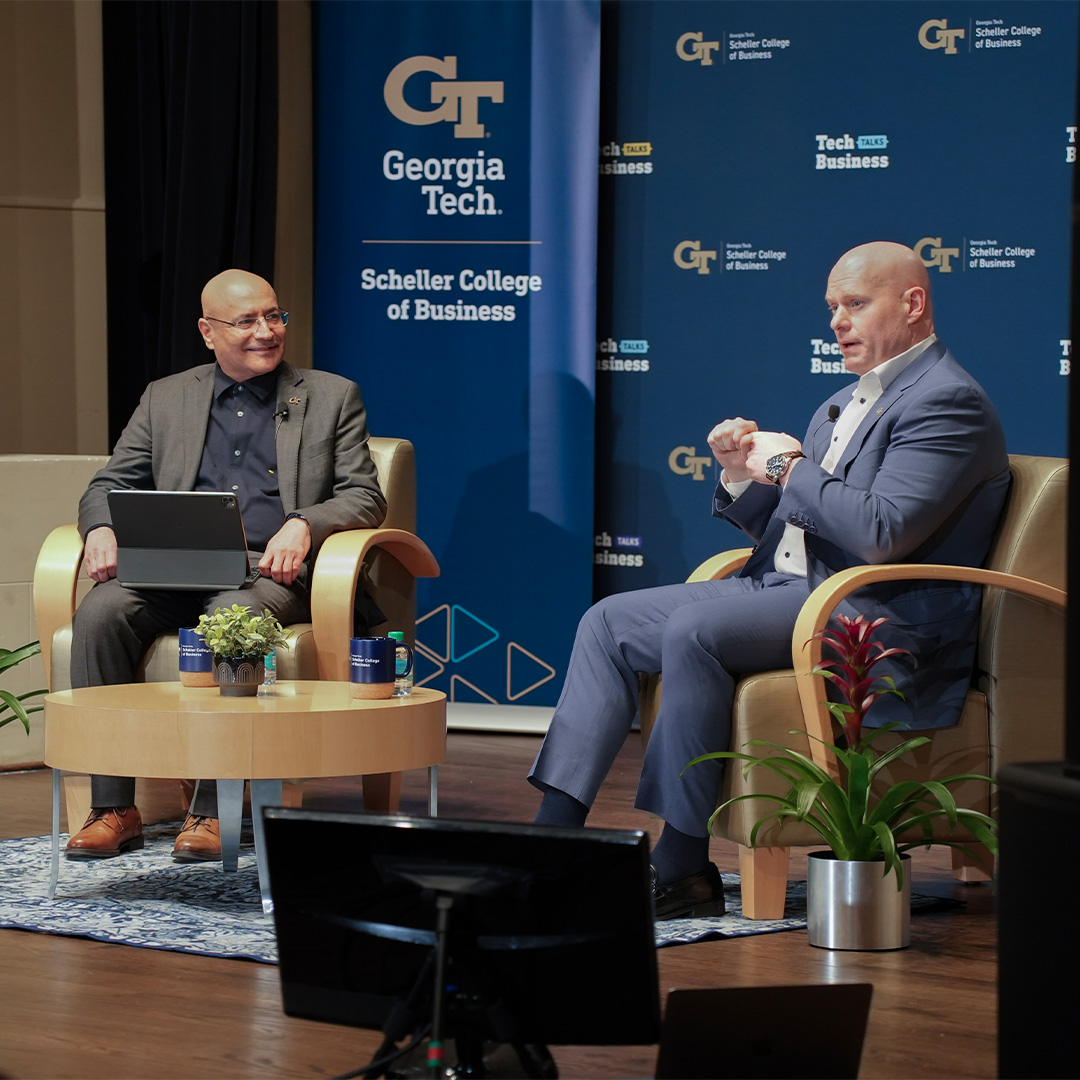
At the Spring 2026 opening session of Tech Talks Business, Dean Anuj Mehrotra welcomed Eric Gray, newly appointed CEO of GE Vernova’s Power Segment. Their discussion explored leadership, energy trends, and the rapid evolution of global power needs. Gray—who stepped into the expanded CEO role just days before this session—brought 25 years of GE experience and a candid perspective on navigating one of the most consequential moments in modern energy.
A Career Built From the Ground Up
Gray described his unconventional path into the energy industry. Originally a chemistry major with his sights set on becoming a doctor, he changed course and accepted a job as a plant chemist at a yet-to-be-constructed Illinois power plant—a role he described as a turning point.
“People saw more in me than what I saw in myself at the time,” Gray shared. “They gave me unbelievable opportunities in operations and as one of the inaugural members of GE’s Project Management Leadership Program.”
From there, Gray advanced through global operations, commercial leadership, and key executive roles, eventually leading GE Gas Power and now, GE Vernova’s entire Power Segment, which includes the company’s Gas Power, Nuclear and Hydro businesses.
Leading Through GE’s Historic Transformation
Dean Mehrotra asked Gray to reflect on GE’s split into three specialized companies—marking the end of a 132-year tenure of one of America’s biggest corporations, one of the biggest corporate restructurings in history.
“At first it was really emotional for me,” he said. “But over time, we’ve proven the value of the company is worth more in pieces than it was in total. It’s allowed us to be nimbler and to cultivate a more focused leadership.”
Inside GE Vernova: Powering America and the World
GE Vernova now operates across three major business segments:
- Electrification (grid equipment, batteries, transformers)
- Wind (onshore and limited offshore)
- Power (gas turbines, nuclear, hydro)
With 25 years in gas turbines, Gray explained the scale and sophistication of GE Vernova’s power technologies—from 35-megawatt mobile units to 600-megawatt installed systems with tolerances “smaller than a human hair.”
AI Demand Is Reshaping the Global Power Landscape
As the conversation turned to the future of energy consumption, Gray painted a vivid picture of an industry bracing for unprecedented demand. He explained that the rapid rise of AI data centers—paired with electrification, EV adoption, and expanding manufacturing—has triggered a global surge in power needs. The trend, he noted, isn’t subtle.
“I completely agree that demand is growing substantially,” Gray said. “There has been very little baseload power installed globally over the last two decades.”
While AI often dominates the headlines, Gray emphasized that the demand spike extends far beyond tech infrastructure. Countries across the world are scrambling to add capacity, from Taiwan’s advanced manufacturing sector to major expansions in the Middle East and Mexico. Data centers may be the accelerant, he explained, but the underlying pressure is a broad, global need for reliable, largescale power generation after decades of underinvestment.
How GE Is Using AI Internally
Gray outlined three major AI programs launched last year to improve productivity, customer value, and product integration. With the use of AI, GE Vernova is leveraging more than 25 years of production data for predictive maintenance and integrate products directly into power plant control systems.
GE Vernova plans to hire 750 engineers this year alone, and Gray stressed that AI will be essential to upskilling new talent quickly.
Culture, Leadership, and Advice for the Next Generation
Drawing on 25 years of experience at GE companies, Gray noted a powerful cultural shift that has sharpened GE’s focus on lean practices and “building problem solvers,” steering the organization toward stronger, more impactful ways of working.
His advice to students interested in exploring careers in energy and sustainability was forthright: “Leaders that embrace AI will be the leaders we need. You’ll have to be the best at how you deploy AI with whatever you do.”
A Wide-Ranging Audience Q&A
The Q&A portion of the event revealed the audience’s wide-ranging interest in the future of energy. Questions touched on emerging technologies such as microgrids and geothermal power, prompting Gray to note that while GE Vernova has explored both, the company sees stronger near-term promise in fuel cells, and other technologies and is directing its efforts there.
When the conversation turned to leadership, Gray highlighted initiative, problem-solving, and hands-on experience as the traits that distinguish future leaders. “I am always looking for individuals that stand out amongst their peer group as natural leaders,” he said, emphasizing that those who improve processes or introduce better ways of working often elevate entire teams.
Audience members also raised concerns about the sustainability implications of the data center boom. Gray explained that meeting this demand will require significant additions of natural gas capacity—an expansion he believes could accelerate coal retirements and support broader decarbonization efforts. The session wrapped with questions about global competition, where Gray underscored GE Vernova’s increasing vigilance in protecting its intellectual property as advanced energy technologies gain strategic importance worldwide.