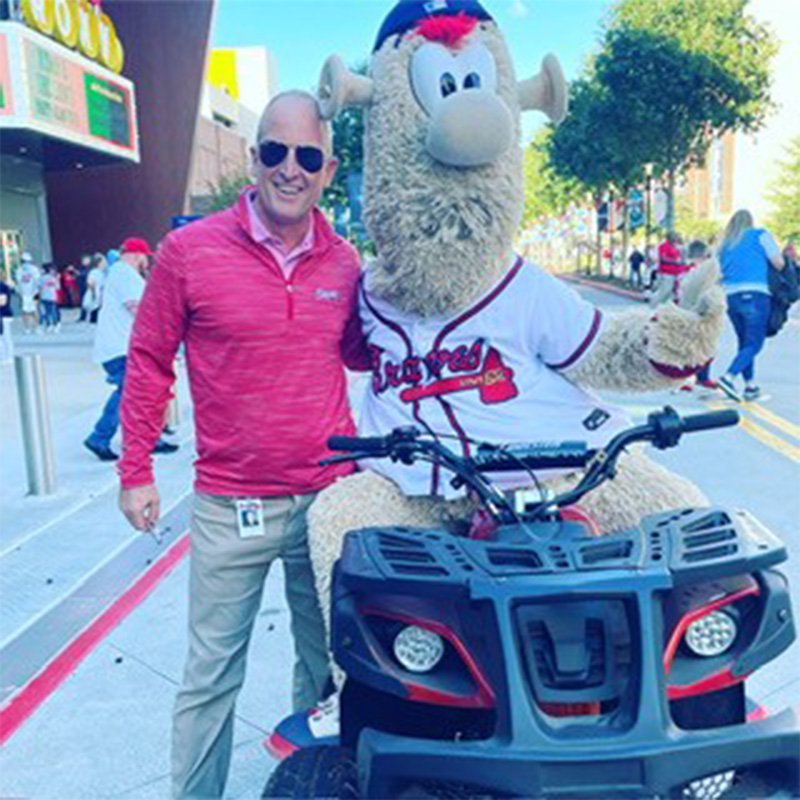
What does it take to build a brand that connects with millions of fans? Adam Zimmerman, senior vice president of marketing and content for the Atlanta Braves, has spent his career doing just that. Whether they’re sitting in the ballpark or following from across the globe, Braves fans are connected by the team’s “Braves Country” brand, a fan experience that extends far beyond game day.
Over nearly a decade with the Braves, Zimmerman has led initiatives spanning marketing, communications, fan experience, digital content, analytics, and emerging technologies, helping shape the strategy behind one of Major League Baseball’s most recognizable brands.
This fall, Zimmerman joins the faculty of the Georgia Tech Scheller College of Business as part of the new Business of Sports and Entertainment minor, bringing students firsthand insight from a career at the intersection of sports, media, technology, and fan engagement.
Keep reading as Zimmerman shares lessons from his career, thoughts on the future of sports marketing, and advice for students looking to break into the industry.

You've spent your career helping shape one of the most recognizable brands in professional sports. What first sparked your interest in sports marketing and content?
My interest in sports business was sparked as an undergrad at the University of Florida, where I worked in the athletic department. It was heightened by a post-grad internship with the University of Michigan’s athletic department.
Looking back on your career, what experiences most prepared you for your current role as senior vice president of marketing and content for the Atlanta Braves?
My entire career has been in the sports business. Throughout my career, I have worked with athletes and broadcasters; identified, negotiated, and activated corporate partnerships and sponsorships on behalf of major corporations; embraced new technologies and the impact of data and analytics; been a part of media companies, and understood the impact of real estate as an asset class. All these skills have helped me in my present role with the Atlanta Braves.
How do organizations like the Braves balance tradition and history with the need to innovate and reach new audiences?
For us, they are the same. The Braves brand and our platform of “Braves Country” allows for both.
Braves fans are loyal and reside all over the world; some have never set foot inside Truist Stadium. How do you build brand experiences for this audience when they only experience the Braves through a screen?
Our brand and brand positioning are consistent, regardless of the medium. Tone and voice matter. As an example, our brand never disparages an opposing team or player.
Fans would experience this brand truism whether they were watching a game from Truist Park, listening to us on the radio, watching us on TV, or following us via our social platforms.
How do you measure success in sports marketing beyond ticket sales or attendance figures?
For us, growth in fandom, merchandise sales, TV ratings, visitors to The Battery Atlanta, an increase in numbers on our social platforms, and an increase in our stock price are all markers of success.
What emerging trends in content creation or fan engagement are you most excited about?
I'm excited to see how the explosive growth of vertical video continues to unfold. The market is expected to generate $150 billion this year alone, a figure that does not include the enormous revenues generated in China.
What separates good marketers from great marketers?
What separates good marketers from great marketers is the ability to say, “Wouldn’t it be cool if?” more often than “My only concern is…”
You are teaching a brand-new course for the Business of Sports and Entertainment Minor this fall. You have a great lineup of industry speakers for the course. What do you hope students take away from your course that they can't learn from a textbook?
I want the Sports and Entertainment Marketing class to hear from a wide range of industry experts who can share their own experiences, provide inspiration for the students, and help illuminate an ever-changing and fast-moving industry.
What skills should students begin developing now if they hope to work in sports marketing, content, or fan engagement?
At the end of the day, sports business is still heavily reliant on excellent interpersonal skills. I would expect today’s students to be best-in-class digital natives and fully embrace both the potential and limitations of AI, but they can always be developing and improving how they communicate and interact with one another, professors, employers, etc. A keen understanding of data and analytics is also a recipe for success.