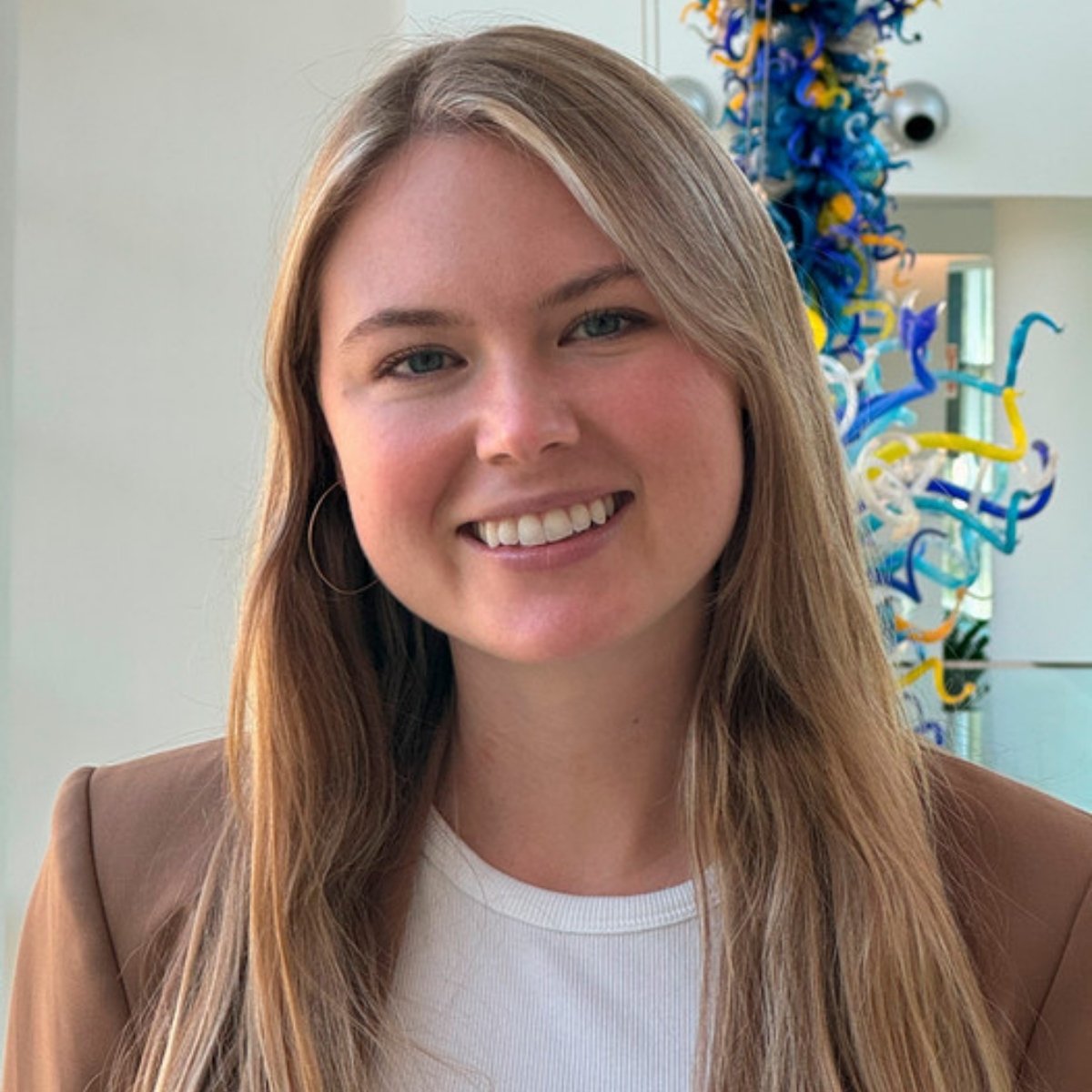
Leading up to each graduation at Georgia Tech, the Scheller College of Business interviews students who are approaching the milestone to hear their reflections. The following article is an excerpt of a profile of Lauren Dasher (MBA ’26). Lauren shares her appreciation for her sustainability-related education, extracurriculars, and mentors at Scheller.
Hometown: Jacksonville, Florida.
Describe yourself in 15 words or less:
Community-oriented strategic thinker with a passion for innovation that serves people and regenerates our planet.
Why did you choose the Scheller College of Business for your MBA?
I chose Scheller for many reasons – the community, strong alumni network, and classroom experience were all at the top of my list. Another factor that truly stood out was the opportunity to get involved with the Ray C. Anderson Center for Sustainable Business (Center). I was inspired by the Center’s regional leadership through initiatives such as the Drawdown Georgia Business Compact and SUSTAIN-X, and knew I wanted to engage as a student. I’m grateful to have had the opportunity to do exactly that.
Describe your community work and leadership roles at Scheller:
In Scheller’s Net Impact - MBA Chapter, I served as first-year representative in 2024-25 and as president in 2025-26. Our club’s goal is to empower Scheller MBAs to center sustainability as a key tenet of business strategy in any organization or role in which they find themselves. To achieve this, our club helps graduate business students build connections with the broader sustainability community, especially in Atlanta, by hosting networking events and panels with sustainability-oriented industry leaders and alumni, organizing community service, and sponsoring travel to national MBA events such as the ClimateCAP Summit and the Leeds Sustainability Case Competition. Scheller has a robust presence at these events, and that’s in large part due to the support we receive from the Center and the Cecil B. Day Program for Business Ethics, as well as the board’s extensive planning. I’d like to give a shout-out to our VPs of finance and professional development, Tilka Persaud and Evan Dodes, for their efforts that made these experiences happen this year!
In 2024-25, I served as a Graduate Sustainability Fellow at the Center. I worked on a project that evaluated the use of an AI waste auditing service for a local client and recommended behavioral strategies for effective implementation and nationwide scaling. It was a great experience. I really enjoyed interacting with the founders of the auditing software. Their energy and passion for their company were contagious.
Who was your favorite MBA professor?
It’s hard to pick only one, but Michael Oxman is a fantastic professor. As managing director of the Center and professor of the practice, he is incredibly knowledgeable about the field of sustainable business. He’s always upbeat and kind, and his classes are engaging – even in the later hours of our evening sessions.
What was the most impactful case study you had in business school, and what was the biggest lesson you learned from it?
My favorite case was “EMMA Safety Footwear (A): Designing a Circular Shoe,” written by one of my professors, Andre Calmon, who is also faculty director of the Center. The case explored what it would take to design the world’s first circular safety shoe and, essentially, whether the company’s existing business model could support it. The case examined the operational, supply chain, and channel implications of embedding circularity into a traditionally conservative industry.
This case was my favorite because it forced us to confront the economics. EMMA’s circular shoe only made sense if the business model evolved alongside the product. The discussion around leasing and product-as-a-service was especially compelling to me because I’m fascinated by how products can be servicized and how that can affect relationships with end users. The case taught me that impact requires organizational alignment. You can’t simply layer sustainability onto a legacy business model and expect it to work.
What business leader do you admire most?
I most admire Yvon Chouinard, the founder of Patagonia, who gave the company away to ensure that all its profits – some $100 million a year – are used to fight climate change and protect the planet’s ecosystems. I admire him because his actions reflect that businesses should be in service of the world and improve life on earth, not endanger it.
What are the top two items on your professional bucket list?
The top item on my professional bucket list is to start a business in education or sustainable nutrition. I’m deeply motivated by the idea of building a product or service that genuinely helps people thrive in mind, body, and spirit end-to-end.
My second goal is to lead strategy at the intersection of profit and purpose. I’m energized by roles where financial performance and long-term impact reinforce one another, and I’d love to help organizations integrate sustainability and human wellbeing into core business strategy.
Read the full profile on Lauren Dasher.