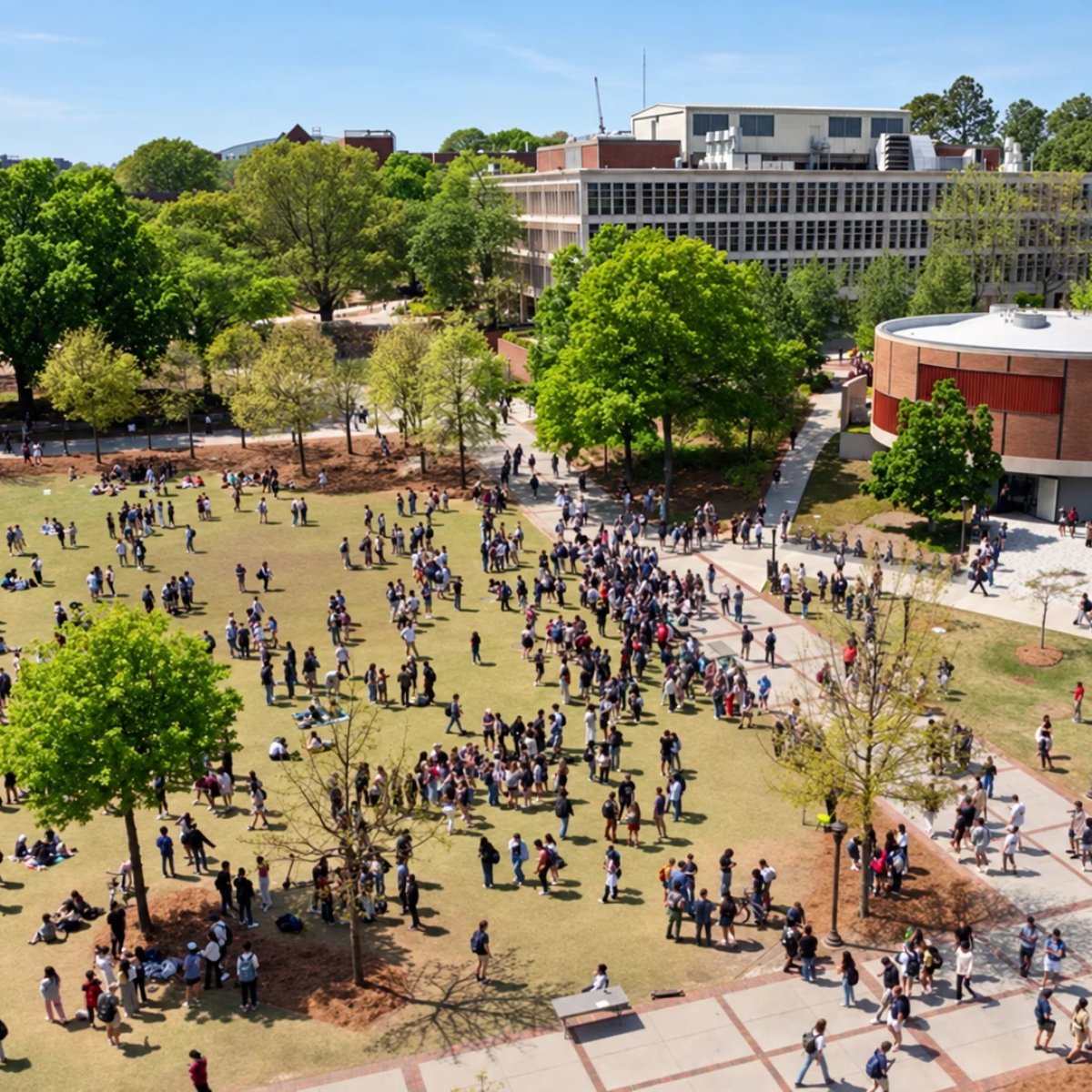
Georgia Tech’s Campus Resilience and Adaptation Framework, released in Summer 2026, was developed by the Office of Sustainability and the Ray C. Anderson Center for Sustainable Business. The framework is intended to guide weather-related mitigation and adaptation planning for the Georgia Tech campus and other similar organizations.
Georgia Tech’s Atlanta campus, home to more than 50,000 students, faculty, and staff, is located in an urban environment increasingly shaped by change. Projections show temperatures rising roughly 4.5°F to 8.5°F by 2085, up to 30 more days above 95°F by mid-century, and heavier rainfall. Key hazards include extreme heat, flooding, drought, poor air quality, and severe storms with high winds.
The Institute is committed to environmental stewardship and innovation in sustainable infrastructure and operations. Georgia Tech has already taken steps to advance sustainability and climate action across the Institute, including the creation of green infrastructure like the EcoCommons that helps manage runoff and heat. Other opportunities include the campus serving as a living laboratory and regional resilience leader.
The framework organizes resilience work into four domains: people, infrastructure, ecological systems, and institutional continuity. It complements the Emergency Operations Plan by focusing on long-term risk reduction and lays the groundwork for a comprehensive plan. Next steps include updating the vulnerability assessment, conducting detailed infrastructure risk analyses, publishing the Hazard Mitigation Plan, and tracking progress with measurable indicators.
Framework co-author Allison Bridges, extension professional at the Ray C. Anderson Center for Sustainable Business, said, “As extreme weather continues to impact our campus, there are few institutions as well positioned as Georgia Tech to respond. With world-class researchers studying heat, flooding, and infrastructure, and staff with deep operational expertise, this framework brings our community together to build a more resilient campus.”