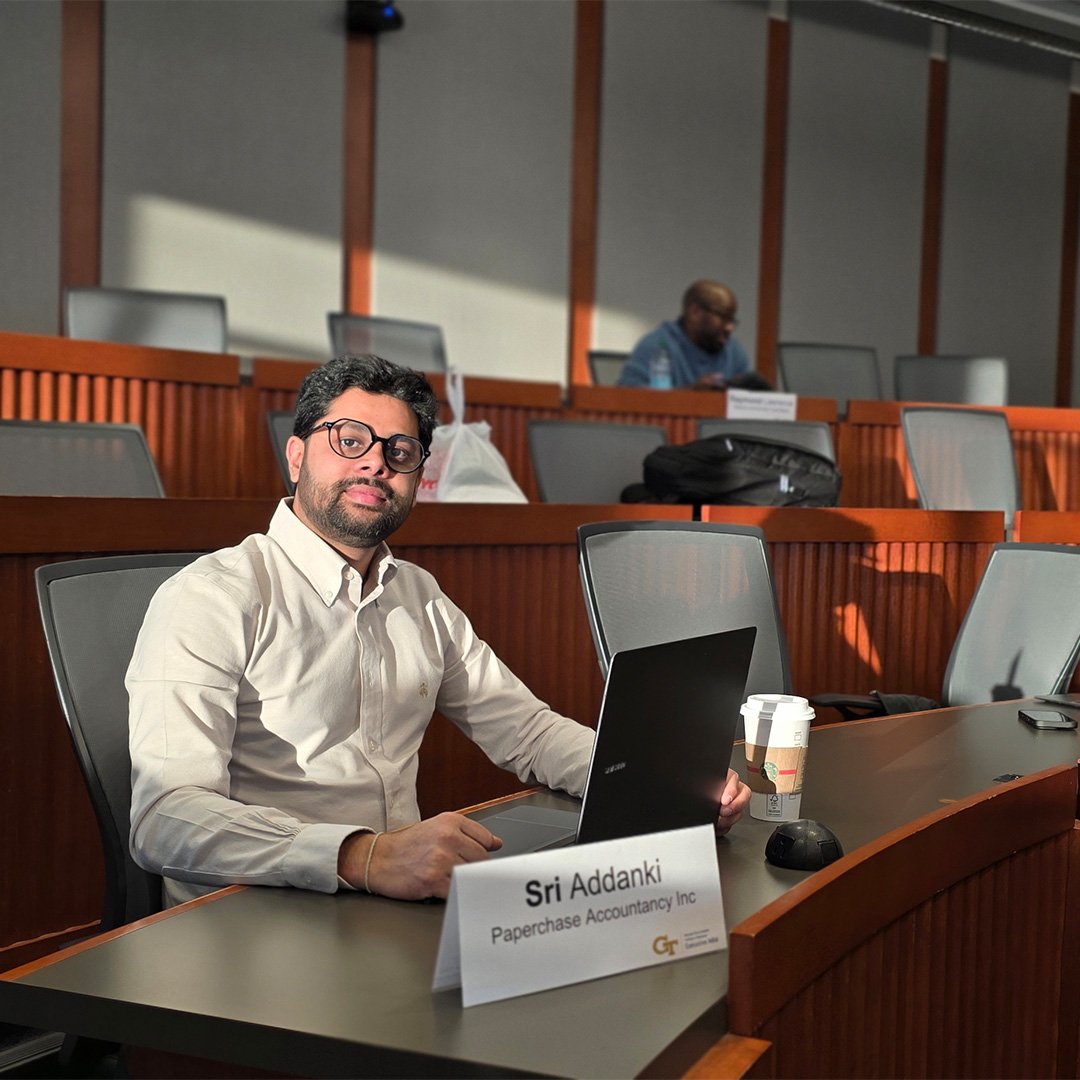
Come the weekend, Sri Addanki, Executive MBA ’26, knows he has a plane to catch. Destination: Atlanta. There are assignments to complete, work to wrap up, and a newborn daughter to think about.
Addanki would be the first to admit that it isn’t easy, and he couldn’t do it without his family’s support. He’d also be sure to share that the flight to Atlanta and weekends spent at the Georgia Tech Scheller College of Business are worth it.
Keep reading to learn more about life as a commuting Executive MBA student.
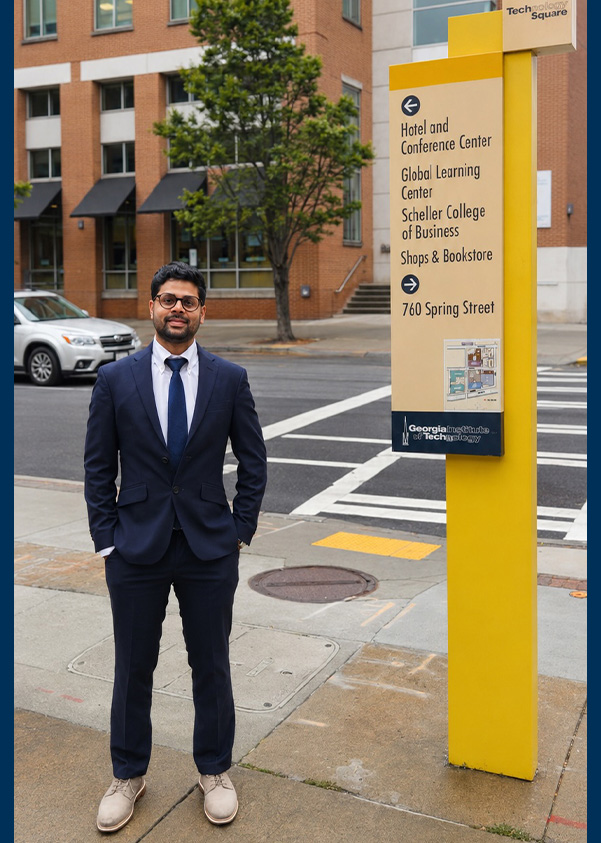
Hometown: Miami, Florida
What do you do professionally?
I am a senior accounting and operations manager at Paperchase Accountancy, Inc. I lead accounting initiatives for hospitality clients, manage cross-functional teams, and advise business leaders on financial performance, process improvement, growth, and strategic decision-making.
Why did you choose the Scheller College of Business Executive MBA program at this point in your career, despite living out of state?
I chose Scheller because I had reached a point in my career where I wanted to grow beyond technical accounting and operational management into broader leadership and client advisory responsibilities. I was looking for a program that would strengthen my strategic thinking, leadership capabilities, and ability to solve complex business problems.
Scheller’s connection to technology, innovation, and practical business application made the program especially attractive. Although living outside Atlanta added another layer of commitment, I believed the quality of the program, faculty, and cohort would make that commitment worthwhile.
How far do you travel to attend classes, and what does a typical weekend of class look like for you?
I travel from Miami to Atlanta for each Executive MBA residency weekend. A typical trip involves flying to Atlanta on Thursday night, working remotely from my hotel on Friday, then spending the weekend immersed in classes, team meetings, and program activities before returning to Miami at the end of the weekend.
The experience requires planning flights, accommodations, transportation, coursework, and professional responsibilities in advance. Class weekends are intensive but also energizing because they allow me to fully step away from my normal routine and focus on learning and engaging with my classmates.
What factors make your commute worth it?
The commute is worth it because of the quality of the classroom discussions, the accessibility of the professors, and the diverse experience represented within the cohort. My classmates come from different industries, functions, and leadership backgrounds, which gives me perspectives I would not gain from my professional environment alone.
Every class weekend provides an opportunity to learn something that I can apply immediately at work, whether it involves leadership, finance, operations, strategy, organizational change, or client advisory.
What does it take to balance travel, work, family responsibilities, and graduate school?
Balancing these responsibilities requires discipline, communication, and careful planning. I organize my work and travel schedules well in advance, establish priorities, and try to complete assignments before travel weekends whenever possible.
It also requires huge support from my family, friends, and colleagues, and especially my wife, Deepthi, whom I am truly grateful for. She is handling her profession, our household, my schedule, and our newborn daughter. Without her support, it would be very difficult to manage this.
I have also learned that balance does not always mean giving equal time to everything. It means being fully present in the responsibility that requires my attention at that moment while maintaining clear communication with the people who depend on me.
How have you built relationships with your cohort despite not being local?
I have made a deliberate effort to be engaged both during and between class weekends. I participate actively in classroom discussions, group projects, social activities, and conversations outside the formal academic setting.
Collaborating on assignments and traveling internationally with classmates have also helped create strong relationships. In addition, co-founding the Emory Georgia Tech Consulting Association has allowed me to work closely with students and leaders across programs while creating experiential consulting opportunities for others.
Although I do not live in Atlanta, I have never felt disconnected from the cohort. The relationships are built through shared experiences, mutual support, and the intensity of completing the program together.
How would you describe the culture of the Executive MBA program?
I would describe the culture as collaborative, ambitious, supportive, and highly engaged. Students are accomplished professionals, but the environment does not feel overly competitive. People are willing to share their experiences, help one another, and contribute different perspectives.
The program encourages students to challenge their thinking while also creating a strong sense of community. There is a genuine interest in seeing classmates succeed personally and professionally.
What do you gain from being physically present with your classmates and professors?
Physical presence creates a level of connection and engagement that is difficult to replicate virtually. In the classroom, I can observe reactions, ask follow-up questions, participate in spontaneous discussions, and learn from conversations that continue during breaks, meals, and team meetings.
Being present also strengthens trust. It allows classmates to understand one another beyond job titles and professional backgrounds. Those personal relationships make group discussions more open, collaborative, and meaningful.
What has been the biggest return on your investment in an Executive MBA so far?
The biggest returns have been the connections I have made, the opportunity to be a part of the Georgia Tech ecosystem, and the transformation in how I approach leadership and business challenges. I have become more confident in moving beyond financial reporting to asking broader strategic questions: What is driving performance? What choices should the organization make? How can leaders align people, processes, and resources around a common objective?
The program has also expanded my network and exposed me to professionals with experiences very different from my own. I have applied lessons from the program directly to my work, strengthened my client advisory approach, and gainedgreater clarity about my long-term goal of moving into strategy, operations, and management consulting roles.