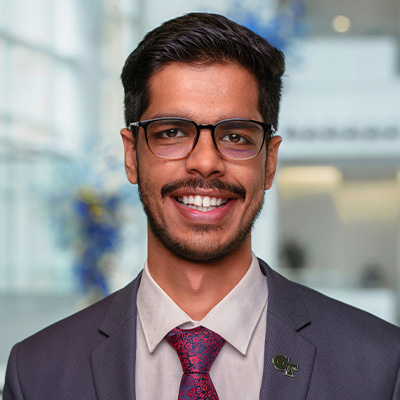
What motivated you to pause your engineering career to pursue an MBA?
During my four years in engineering, I genuinely enjoyed solving technical problems. Over time, however, I found myself asking broader questions: How does this product truly create value? Why are we prioritizing this initiative over others? How does this decision affect revenue or long-term strategy?
That curiosity pushed me to reflect on where I wanted to grow. I didn't want to leave my technical foundation behind; I wanted to build on it. I realized that while I could execute solutions effectively, I lacked the business fluency to influence the strategic direction behind them. Pursuing an MBA felt like the most intentional way to translate complex technical capabilities into meaningful business impact.
What challenges did you face during the transition from engineering to business school?
The biggest challenge for me was networking. As an individual contributor in engineering, I primarily focused on execution and delivering results within my team. I didn’t naturally invest time in building broad professional relationships because my work was more siloed.
I quickly realized that in business school, relationships are central to learning, recruiting, and growth. Shifting from a task-oriented mindset to a relationship-oriented mindset
required intentional effort and practice.
How has your engineering background influenced your approach to MBA coursework?
My engineering training gave me a 'first principles' mindset. I tend to deconstruct complex business cases into smaller, logical components, ensuring every recommendation is based on data rather than just intuition.
I’ve also learned that insight is only as valuable as your ability to communicate it. I’m now focusing on how to translate technical data into a compelling narrative that aligns stakeholders and drives strategic action.
Are there specific concentrations or electives you think are especially helpful for students transitioning from engineering?
I have really enjoyed the Product and Service Innovation concentration because it sits at the intersection of technology and business. As an engineer, it feels like a natural bridge to learn how to translate technical depth into customer value.
Additionally, the Emerging Technologies elective provides a structured framework to evaluate the commercial implications and adoption risks of trends like AI, blockchain, and biotechnology.
Which skills from your engineering training have been most valuable during your MBA program?
The most valuable skill has been structured problem solving. Engineering trained me to approach ambiguity methodically, define assumptions clearly, and test solutions logically. This mindset has been extremely helpful in case discussions, group projects, and high-pressure recruiting preparation.
Were there any knowledge gaps you wish you had addressed before starting your MBA?
The professors at Scheller are world-class and do an incredible job of ensuring students don't need extensive prior knowledge to succeed. However, coming from an engineering background, I wish I had built a stronger foundation in accounting and finance. While I was comfortable with complex numbers, the "language" of financial statements and valuation concepts was a new shift that a bit of pre-study would have made even smoother.
How have you approached building a professional network as someone shifting from engineering into business?
I’ve leveraged my technical background to connect with product managers who share similar roots, using Scheller's strong network to facilitate one-on-one coffee chats. I also became active in student organizations and small group settings, which helped me build genuine relationships based on shared interests. This made networking feel less like a formal requirement and more like a natural, curiosity-driven conversation.
What career paths are you exploring that blend (or build on) your engineering background and your MBA training?
I am targeting product management and technology strategy roles. These paths allow me to use my technical background to understand products deeply, while also applying business frameworks to drive growth, prioritization, and long-term strategy.
How do employers seem to perceive candidates with engineering backgrounds applying for business roles?
Employers generally value the analytical rigor and structured thinking that engineers bring, often assuming engineers can handle high levels of complexity and data. To stand out, however, it’s essential to demonstrate transferable skills — proving you can bridge the gap from technical execution to clear communication and commercial results.
What advice would you give someone considering an MBA after working in engineering?
Embrace ambiguity. Engineering is often about finding the "right" answer, but business is about making the best decision with incomplete information. Don't underestimate soft skills; investing in communication and leadership will accelerate your transition. Finally, view your engineering background as a powerful asset to build upon, not something you are trying to move away from.
What resources — such as books, podcasts, or mentors — have been especially helpful in your journey?
I start every day with the “Morning Brew Daily” podcast to stay up to date on business news and listen to “The Acquired” podcast for deep dives into corporate strategy. Most importantly, the Scheller alumni and second-year MBA students have been my greatest resource. The community here is incredibly supportive; hearing how others navigated similar transitions helped me map out my own path with confidence.
What future trends in the engineering industry do you think MBA students should be aware of?
Artificial Intelligence is no longer a buzzword; it is fundamentally reshaping how
companies prioritize investments and deliver value. At the same time, there is a growing, human-centric pressure around sustainability. Engineering decisions are no longer evaluated only on performance and cost, but also on environmental impact and long-term resilience.
How can someone effectively leverage their engineering experience in business settings?
Start by translating your technical work into business outcomes. Instead of describing what you built, explain the value it created or the revenue it enabled. Use your structured thinking as a strength in ambiguous situations but pair it with empathy. The combination of analytical rigor and business judgment is what truly differentiates engineers in leadership roles.