Hometown: Atlanta, Georgia
Describe yourself in 15 words or less:
Veteran leader building teams, driving growth, and solving complex problems with discipline.
Where was the last place you worked before enrolling in business school?
United States Army, Logistics Officer, Captain O-3
Where did you intern during the summer of 2025?
I was an MBA growth marketing intern at Instawork. I worked remotely from Atlanta supporting national growth operations. I also spent time in San Francisco collaborating with the core team.
Where will you be working after graduation?
I am extremely excited to share that I will start work as a consultant for The Alexander Group following graduation in May. I will be working in the Atlanta, Georgia office.
Community Work and Leadership Roles while attending Scheller College of Business:
- President, MBA Veterans Club: I lead programming focused on professional development, community building, and veteran recruiting. Organize speaker events with veteran executives, strengthen alumni engagement, and expand cross program collaboration.
- MBA Ambassador and Admissions Interviewer: Represent Scheller in prospective student interviews, panels, and coffee chats. Help candidates evaluate program fit and culture.
• Consulting Club Member: Active participant in case prep groups and peer coaching for consulting recruiting. - Peer mentor to first-year students: Support students navigating recruiting, academics, and transition into business school.
Which academic or extracurricular achievement are you most proud of during your time at Scheller?
I am most proud of serving as president of the MBA Veterans Club. Transitioning from the military into business can feel isolating, and I want every veteran at Scheller to feel seen, supported, and prepared. We expand professional development programming, increase collaboration with alumni, and strengthen relationships with corporate partners interested in veteran talent. The most meaningful outcome was not a single event but watching first year veteran students gain confidence and clarity about their post-MBA path. That sense of community is something that will outlast my time at Scheller.
What achievement are you most proud of in your professional career?
The achievement that means the most to me is the time I spent leading soldiers in the United States Army. I will always be grateful for the opportunity to work alongside and learn from some of the most dedicated Americans I have ever met. The military brings people together from every background imaginable — different regions, cultures, economic circumstances, and life experiences — and unites them around a shared mission. It is one of the most diverse and purpose-driven organizations in the world.
While I am proud of the operational outcomes — successful missions, disciplined supply chain execution, and strong performance evaluations — those are not the moments that stay with me. What I value most are the conversations that happened quietly, when a soldier pulled me aside to say that I made a difference in their life. Some told me I helped them through difficult personal moments. Others said I was the best junior officer they had worked with in careers that spanned decades. Those words mean more to me than any medal or rank ever could.
For me, leadership has never been about authority or achievement alone. It is about influence, trust, and service. I hope to carry even a fraction of what I learned about leading people in the Army into every team and organization I serve in the future.
Why did you choose the Scheller College of Business?
I chose Scheller because of the strength of the Jones Career Center, especially as I transitioned from the military into the civilian business world. Moving from the Army into consulting requires more than updating a resume. It requires translating leadership, logistics, and operational experience into language that corporate employers immediately understand. That bridge is not automatic.
Melissa Davis, my career coach, played a critical role in that transition. She helped me reframe my experience, sharpen my story, and position myself competitively in consulting recruiting. More importantly, she provided steady guidance through a process that can feel unfamiliar and uncertain for veterans. Her support turned what could have been a difficult transition into a confident launch into my post-MBA career.
Who was your favorite professor?
Dr. Narayanan Jayaraman. I had the privilege of taking both Corporate Restructuring and Entrepreneurial Finance and Private Equity with him. What stood out most was not just his depth of expertise, but his genuine care for students. With decades of experience at Georgia Tech, he brings perspective that goes far beyond the textbook.
Finance can easily become technical and abstract. Dr. Jayaraman consistently grounded complex valuation models and capital structure discussions in real human decisions and long-term consequences. He reminded us often of why we are here, and what purpose in life we work for, not just the results and time we put in but the family and life outside work. He transformed what could have been dry, numbers-driven courses into conversations about responsibility, judgment, and leadership.
What was your favorite course at Scheller?
My favorite course was the International Practicum in Japan. Our team partnered with Central Japan Railway Company, which operates the high-speed rail lines between Tokyo and Kyoto. Over the course of the semester, four classmates and I collaborated closely with a JRC team based in Japan to analyze a strategic business challenge.
What made the experience exceptional was the depth of engagement. We were not completing a theoretical case. We were working across time zones with executives and managers on real operational questions. During spring break, we traveled to Japan to meet our partner company in person and engage with other organizations participating in the practicum.
It was a once in a lifetime experience that combined strategy, operations, culture, and teamwork. I will always be grateful for the opportunity to represent Scheller abroad and to build relationships that extended far beyond the classroom.
What was your favorite event or tradition at Scheller?
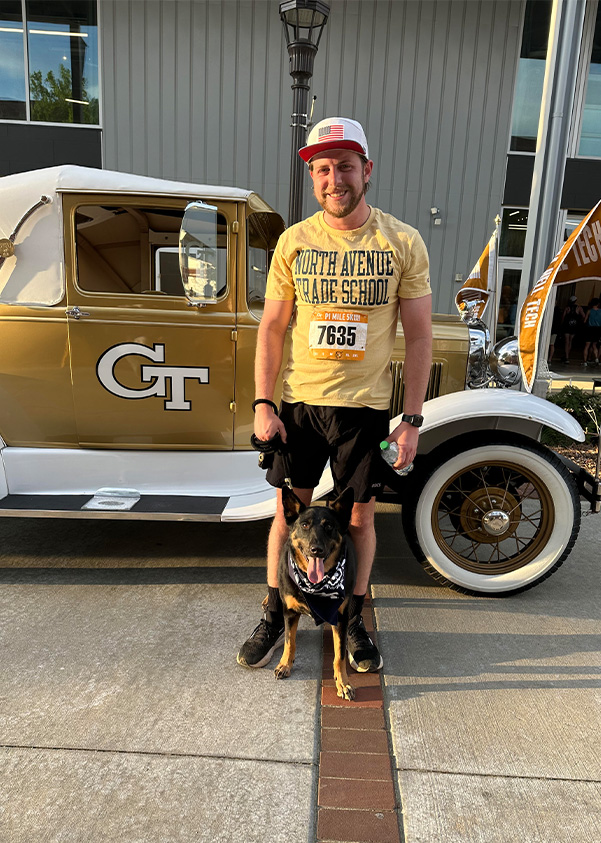
Scheller hosts countless social events each week, but my favorite happens quietly every Thursday morning at sunrise. The weekly Pi Mile brings together between ten and thirty current students and alumni from the Full-time, Evening, and Executive MBA programs to run, jog, or walk 3.14 miles together.
We run the Tyler Brown Pi Mile Trail, a loop that runs around much of Georgia Tech’s campus dedicated to Tyler Brown, a former Student Government Association president and ROTC cadet who was killed in action in Iraq in 2004. The run carries meaning beyond exercise. For me, it echoes early mornings in ROTC and the Army, moving with a team as the sun rises. My dog Brandy often runs alongside us, which makes it even more personal.
The Pi Mile reflects what makes Scheller special. It brings together students across programs and alumni who return simply because they want to stay connected. It blends tradition, service, wellness, and community in a way that feels authentic rather than forced. It is a reminder that business school is not only about careers. It is also about shared experiences and lasting relationships.
Looking back over your MBA experience, what is the one thing you’d do differently and why?
I would approach the internship search differently. The first year of an MBA is a whirlwind of academics, social events, and recruiting pressure. For someone transitioning from the military, it can feel especially unfamiliar. Coffee chats and networking conversations are not part of military culture, and many of the roles and industries are completely new.
At the time, I focused heavily on networking and outreach. While relationships absolutely matter, I now recognize that I would have benefited from spending more time deeply understanding industries, business models, and role-specific skill sets. The job market has shifted, and companies increasingly prioritize candidates who demonstrate informed conviction about their target industry, not just strong interpersonal skills.
If I could do it again, I would balance networking with more structured industry immersion early on. That knowledge builds confidence, sharpens conversations, and ultimately makes networking far more effective.
What was the most impactful case study you had in business school and what was the biggest lesson you learned from it?
One of the most impactful cases for me was a supply chain digitization case on Nike. Nike had set ambitious growth targets through its consumer direct strategy, yet its legacy distribution infrastructure was not built to support faster, digitally driven fulfillment. The tension between strategy and operational capability became the central issue.
The biggest lesson I learned was that strategy and execution cannot be separated. A compelling growth narrative means little if the underlying systems, processes, and incentives are not aligned to deliver on that promise. The case reinforced that operational constraints are often the hidden variable in strategic failure. As someone with a background in logistics, it sharpened my belief that sustainable competitive advantage is built as much in warehouses and process design as it is in boardrooms.
What did you love most about Scheller's location in the heart of Midtown Atlanta?
I am admittedly biased when it comes to Atlanta. I was born and raised here, and when I left the Army, I made a deliberate decision to return. After traveling throughout the United States and overseas, I have come to believe that Atlanta is often misunderstood. One of its lesser-known nicknames is the “City in the Forest,” and it is well earned. The tree canopy, rivers, and green space give the city a character that feels both vibrant and grounded.
You can run or walk along the Atlanta Beltline, kayak down the Chattahoochee River, or drive north and hike near the start of the Appalachian Trail. Few cities offer that combination of professional opportunity and immediate access to nature. For me, Atlanta represents both home and possibility, which made earning my MBA here even more meaningful.
What business leader do you admire most?
I admire Satya Nadella most for how he transformed Microsoft through culture before strategy. When he became CEO, Microsoft was financially strong but culturally stagnant. Rather than leading with cost cutting or restructuring alone, he focused on growth mindset, empathy, and collaboration. That cultural shift unlocked innovation in cloud computing and AI and repositioned Microsoft as a technology leader.
What resonates with me is his belief that leadership begins with humility. In both the Army and business school, I have seen that culture drives performance. Nadella proves that disciplined strategy and human-centered leadership are not opposites. They reinforce each other. As someone who has led in high accountability environments, I admire leaders who understand that culture is not soft. It is infrastructure.
What is one way that Scheller has integrated AI into your programming? What insights did you gain from using AI?
Georgia Tech has embraced AI across its curriculum, but what impressed me most is how faculty research is directly shaping classroom instruction. Courses such as Managing Information Resources, Machine Learning for Business, and AI in Business are not static electives. They reflect active research and evolving industry applications, which means students are learning from professors who are contributing to the field in real time.
Through these courses, AI shifted from being a buzzword to a practical decision tool. I learned how to frame business problems in ways that make them solvable with data, how to evaluate model outputs critically, and how to balance automation with human judgment. The biggest insight I gained is that AI does not replace strategic thinking. It amplifies it. Leaders who understand both the technical foundations and the business context will have a meaningful advantage in modern organizations.
Which MBA classmate do you most admire?
I most admire Michael Dunn, my vice president in the Veterans Club. Mike is a strong example of what a successful transition from the military to business school can look like. He pursued recruiting in an industry that is not traditionally aligned with military experience, yet he approached it with humility, preparation, and relentless effort. Watching him navigate a completely new field and consistently succeed has been both impressive and motivating.
What makes our friendship even more meaningful is how it started. He was the first person I spoke to at orientation. I asked the usual opening question about where he had just moved from, and I was surprised to learn that he had been stationed at Fort Campbell, Kentucky, only a mile from where I had worked for four years. He served in 5th Special Forces Group while I was on the same installation. We likely crossed paths countless times without realizing that we would one day sit across from each other in the same MBA program.
Since that first conversation, we have worked through consulting cases together, attended football tailgates, led Veterans Club meetings, and shared countless early mornings and late nights. His discipline, integrity, and steady presence reflect the kind of classmate and leader that elevates everyone around him.
What are the top two items on your professional bucket list?
First, I aspire to lead a consulting team that tackles complex business challenges and delivers measurable results. I want to be responsible not only for the quality of the analysis, but for the cohesion and performance of the team solving the problem. Consulting offers the opportunity to step into high stakes environments where clarity, structure, and execution matter. My goal is to lead teams that bring disciplined thinking and practical solutions to organizations facing pivotal decisions. Just as in the Army, I believe the strongest outcomes come from aligned teams operating with shared purpose and accountability.
Second, I want to continue mentoring others throughout my career, especially those transitioning from the military into business. One of the aspects I miss most from the Army is the daily opportunity to coach and develop junior soldiers. Watching someone gain confidence, refine their skills, and exceed their own expectations is incredibly rewarding. I want to recreate that environment in the corporate world by investing time in young professionals and helping them navigate uncertainty with structure and purpose.
Fun fact about yourself:
I believe the biggest changes in life often happen without a plan. While I was training in the Tennessee woods during my time in the Army, I found an abandoned dog miles from anything. Three years later, Brandy (my dog) now fills most of my free time and has brought more joy into my life than I ever expected.